You're dressing for a full day. The morning calls for something simple, the office calls for something polished, and an evening dinner suddenly makes you wish you'd planned a little better. A pair of gold stud earrings can handle that change without asking you to rebuild your outfit from the beginning.
The trick is choosing studs as part of a jewelry wardrobe system, rather than treating every pair as interchangeable. Karat, construction, post material, size, backing, and styling all affect how a stud looks and feels. For Canadian shoppers, material labels matter especially when sensitive ears, long-term wear, and value are part of the decision.
Gold also sits within a substantial Canadian precious-metals economy. In 2024, Canada's gold imports reached $19.5 billion, including 350 tonnes of unwrought gold valued at $19.2 billion, according to Canada gold jewellery import data. Those figures don't tell you which stud to buy, but they do provide useful context. Gold jewellery is connected to an active, documented supply chain, not a tiny isolated fashion niche.
Table of Contents
- Introduction to Gold Stud Earrings and Why They Belong in Every Jewelry Box
- What Makes Gold Stud Earrings Different From Other Earring Styles
- Understanding Gold Types Karats Colours and Construction for Stud Earrings
- How to Choose the Right Size Shape and Backing for Comfort and Style
- Styling Gold Stud Earrings for Everyday Office and Formal Occasions
- Caring for Gold Stud Earrings and Keeping Sensitive Ears Happy
- Finding Your Perfect Pair of Gold Stud Earrings at Fashion Bags and More
Introduction to Gold Stud Earrings and Why They Belong in Every Jewelry Box
A stud earns its place through adaptability. It can sit beneath a curtain of hair during a workday, add a warm point of colour to a knit sweater, and still look appropriate with a dress or jumpsuit at night. Unlike a long drop or oversized hoop, it rarely competes with the rest of your outfit.
That makes the gold stud earring a useful starting point for building a collection. A small pair can serve as an everyday default. A second pair can fill a higher piercing for an ear stack. A more detailed design, perhaps with a bezel-set stone, can provide evening polish without the weight or movement of a dramatic earring.
Practical rule: Choose your first pair for the way you live most days, not for the occasion you attend least often.
The right choice depends on more than colour. You'll want to understand what a karat mark means, how yellow, white, and rose gold differ, and why a solid gold post deserves as much attention as the visible front. You'll also need to consider size, shape, backing, sleep habits, glasses, hair, and whether your ears react to nickel or other alloy metals.
A simple way to think about your collection
Treat studs like shoes in a practical wardrobe:
- Everyday pair: Comfortable, secure, and understated enough for repeated wear.
- Stacking pair: Small enough to sit neatly in a second or third piercing.
- Formal pair: More luminous or detailed, with a gemstone, pearl, cluster, or sculptural finish.
- Sensitive-ear pair: Selected by its post and backing materials, not just its gold-coloured surface.
Canadian trade data also shows that precious-metal jewellery is commercially active across provinces including British Columbia, Alberta, and Ontario. A 2024 Canadian dataset for HS 711319 recorded Can$424,443,316 in total imports among three major importers, while another trade report recorded 5,104 gold jewellery shipments from June 2024 to May 2025. You can review the Government of Canada jewellery import records for that market context.
By the time you finish choosing, you should be able to look at a pair of stud earrings gold and ask better questions. Is it the right karat for your routine? Does the post suit your ears? Will the size work with your hair, glasses, and other piercings? Does it give you more than one styling option?
What Makes Gold Stud Earrings Different From Other Earring Styles
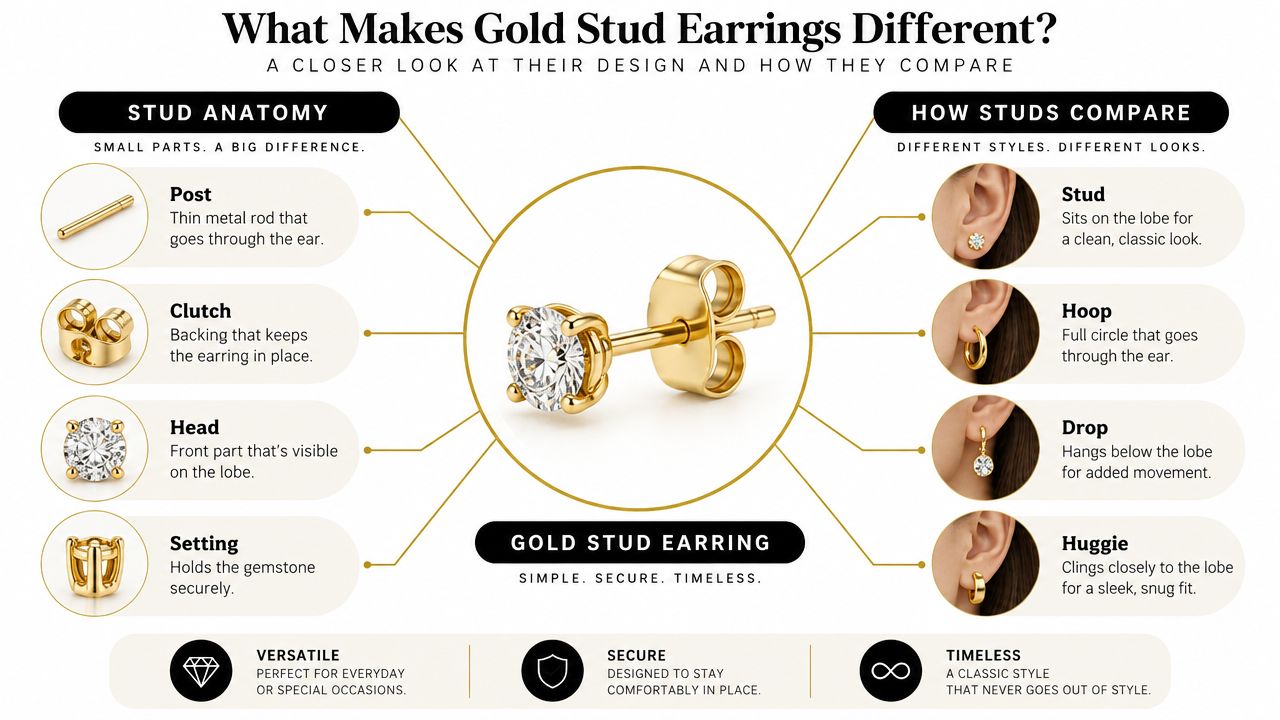
A stud is built around a short post that passes through the piercing. The front, or head, remains visible on the lobe, while a clutch or other backing holds the earring in place behind the ear. If the stud includes a gemstone, the setting is the small structure that grips or surrounds it.
Think of the post as a narrow peg, the backing as a stopper, and the front as the decorative button. That simple arrangement keeps most of the weight close to the ear instead of allowing it to swing below the lobe.
How studs sit differently from other earrings
A hoop forms a circle or partial circle through the piercing, so it follows the ear and creates visible movement. A drop extends below the lobe and can change position as you walk. A huggie curves closely around the lobe, creating a compact outline that usually feels more substantial than a tiny stud.
The stud stays close to the lobe. That makes it useful for active days, commuting, school, office settings, and outfits where you want your earrings to support rather than dominate the look. It also makes studs natural companions for other earrings because their visual footprint is controlled.
The material changes the experience
Gold isn't a single uniform material. A higher gold content can create a richer colour and a softer feel, while added alloy metals can increase hardness. Construction affects the result too. A well-fitted post and smooth clutch may feel comfortable even in a modest design, while a poorly finished post can irritate the ear regardless of how bright the front looks.
The setting matters when a stud contains a stone. A bezel surrounds the stone with a smooth rim, while prongs hold it at separate points. The choice changes the profile, texture, and snagging risk. A low-profile bezel can work well for daily wear, while a raised cluster may offer more sparkle but require greater awareness around hair and clothing.
A stud shouldn't feel like a tiny weight hanging from your lobe. It should feel like a secure point of light that stays where you placed it.
Before comparing karats, inspect the whole earring. Look at the post, the back, the join between the post and front, and the way the decorative head sits against the ear. Shine catches attention first, but construction determines whether you'll reach for the pair tomorrow.
Understanding Gold Types Karats Colours and Construction for Stud Earrings
Gold quality is expressed through karat marks from 9K to 24K under Canada's federal Precious Metals Marking regime. A 14K mark means the piece is intended to represent about 58.3% gold content, while the rest consists of alloy metals that influence colour, strength, and working properties.
Canadian marking rules also set tolerances. The permitted difference is 3 parts per 1,000 by weight when no solder is used, and 7 parts per 1,000 when solder is used. For 18K white gold with solder, the tolerance is 15 parts per 1,000. You can read the Competition Bureau's detailed precious-metals marking requirements before relying on a stamp.
Karat and construction in one view
| Karat and Construction | Gold Content and Hardness | Best For |
|---|---|---|
| 9K solid gold | Lower gold content than higher-karat options, with a greater alloy share that generally supports hardness | Budget-conscious everyday styles, provided the wearer confirms the alloy system |
| 14K solid gold | About 58.3% gold content, with added alloys that usually make the piece harder and more scratch-resistant | Daily wear, stacking, and shoppers who want a balance of durability and gold content |
| 18K solid gold | Higher gold content and a richer colour, with more softness than lower-karat gold | Premium everyday wear, gifting, and buyers who value colour and gold content |
| 24K gold | Very high gold content and a naturally rich colour, but softer than common jewellery alloys | Special designs and buyers prioritising gold content over everyday hardness |
| Gold-filled | A gold layer bonded to another metal core | Shoppers seeking a middle ground, after confirming post and backing materials |
| Gold-plated | A surface layer over a base metal | Occasional wear, only when the seller clearly discloses the core and skin-contact metals |
The table gives general material logic, not a guarantee for every design. Alloy recipes, thickness, solder, finish, and manufacturing quality all affect the final experience.
Colour is a style decision, not a quality grade
Yellow gold offers the familiar warm tone associated with gold. White gold creates a cooler, silver-like appearance, but shoppers with sensitive ears need to ask what alloys are used because white gold may contain nickel. Rose gold gets its blush tone from copper-rich alloying, so its colour is distinct from yellow or white gold even when the karat is the same.
For sensitive ears, the post deserves priority over the front. Canadian guidance identifies nickel and cobalt as common causes of jewellery allergy, and it notes that 9K gold and white gold may contain nickel. The term “hypoallergenic” also isn't legally defined in Canada, so ask for the exact metal touching the piercing instead of accepting the label alone. Canadian jewellery allergy guidance explains why the visible gold colour doesn't tell the whole story.
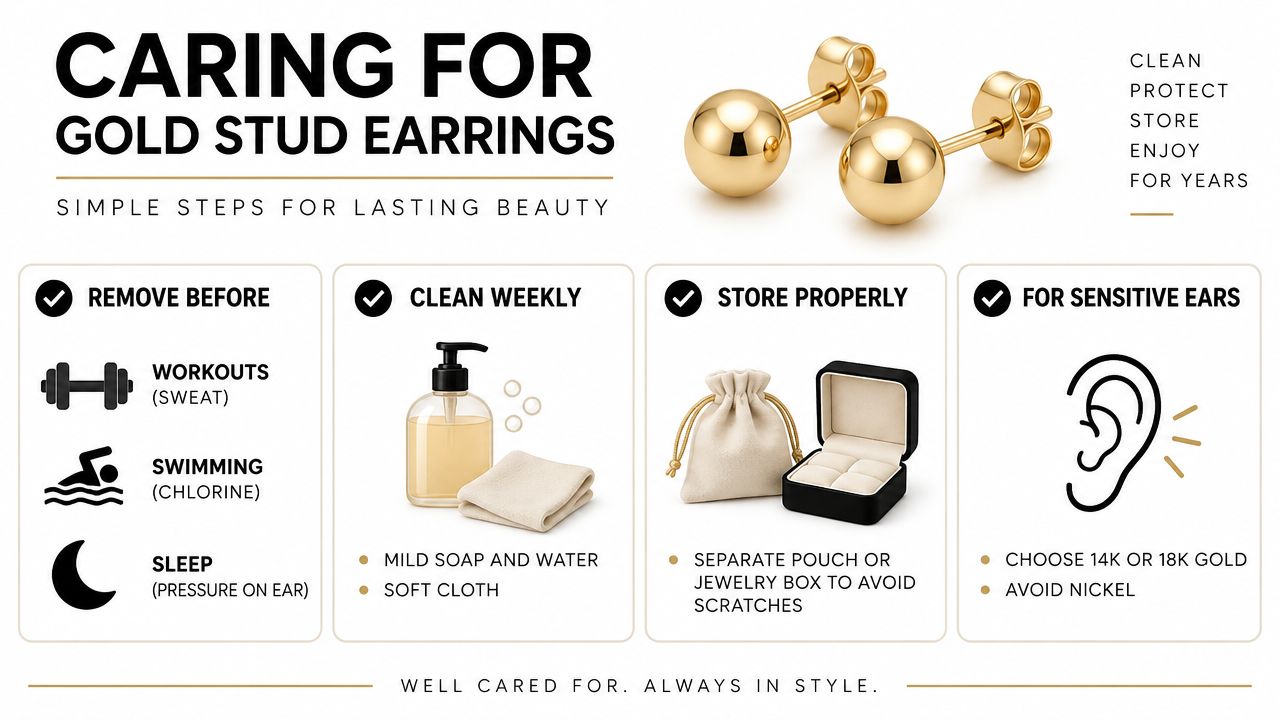
Solid 14K or 18K gold may be a sensible starting point for severe sensitivity, but the post, backing, solder, and any plating still need confirmation. An earring can look gold while hiding a reactive base metal at the point that matters most.
How to Choose the Right Size Shape and Backing for Comfort and Style
Size changes the mood of a stud more than many shoppers expect. A tiny dot can disappear into a minimalist outfit, while a larger round or cluster design becomes a focal point. The right size also depends on piercing placement. A stud that looks balanced in a first lobe may crowd a second piercing if both fronts are broad.
Start with the ear, then consider the outfit
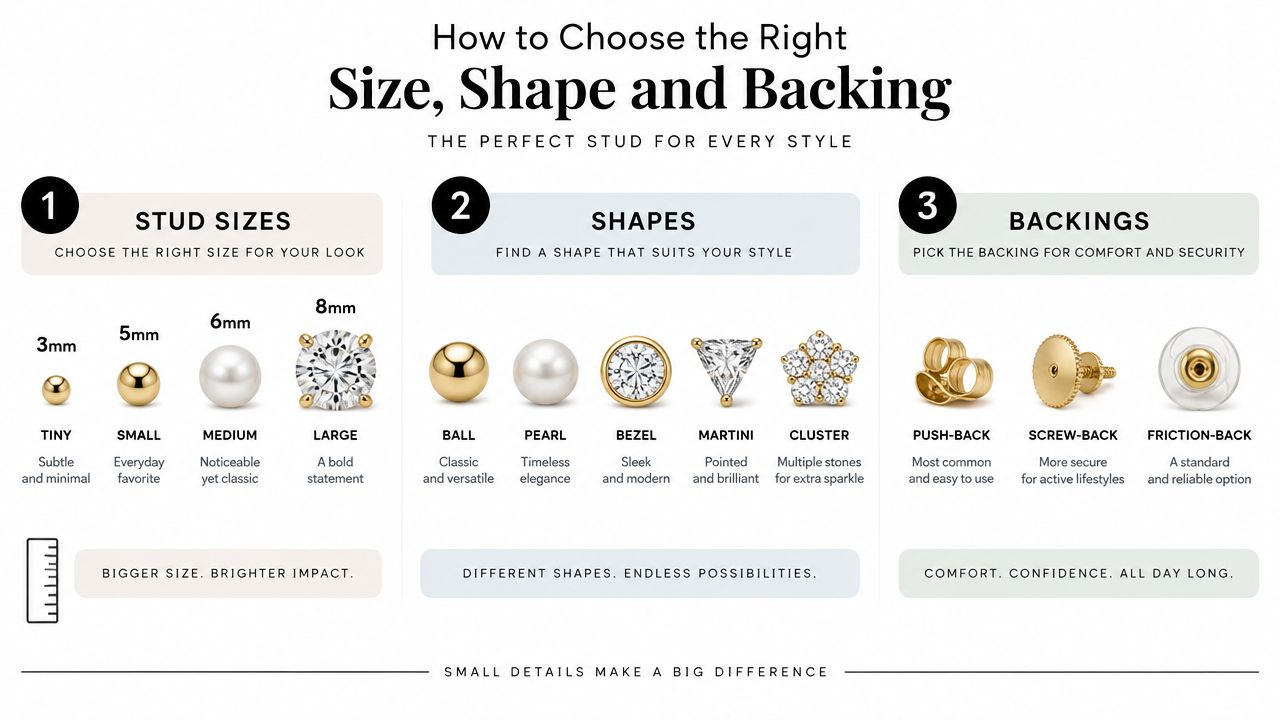
Use the diameter as a visual filter:
- Around 3mm: A quiet dot for a first piercing, a professional dress code, or a second piercing.
- Around 5mm: A noticeable but restrained ball or geometric front.
- Around 6mm: A versatile pearl or bezel style with enough presence for everyday outfits.
- Around 8mm: A statement stud that can anchor a simple look.
These measurements are useful style references, not rules. A flat square may appear wider than a round stud at the same measurement, while a raised cluster may look larger because it catches more light.
Shape adds another layer. Balls feel clean and uncomplicated. Pearls soften a look. Bezels create a neat frame around a stone. Martini-style settings can give a gemstone a pointed, lifted profile. Clusters produce more sparkle and visual detail, which may suit formal dressing better than a plain dot.
Backings decide how the pair behaves
A butterfly or friction-back is familiar and easy to use. A screw-back takes longer to remove but can feel reassuring for sleepers, children, or anyone who worries about losing an earring. A flat-back places a flatter surface behind the lobe, which can be useful for sleeping or for piercings where a projecting clutch causes pressure.
Check the backing against your routine:
- For busy daytime wear, choose a smooth, secure backing that doesn't catch on hair.
- For a second piercing, keep the front small and avoid a backing that presses against the first earring.
- For glasses wearers, compare the earring back with the arm of your glasses and the way both sit behind the ear.
- For thick or long hair, prioritise a post and clutch that won't snag during brushing.
- For formal occasions, you can choose more height or detail, provided the weight remains comfortable.
A mirror helps, but touch matters too. The front should face forward instead of tipping down, and the backing shouldn't pinch the lobe. If the earring rotates constantly, the problem may be the post angle, the backing fit, or the balance of the decorative head.
Styling Gold Stud Earrings for Everyday Office and Formal Occasions
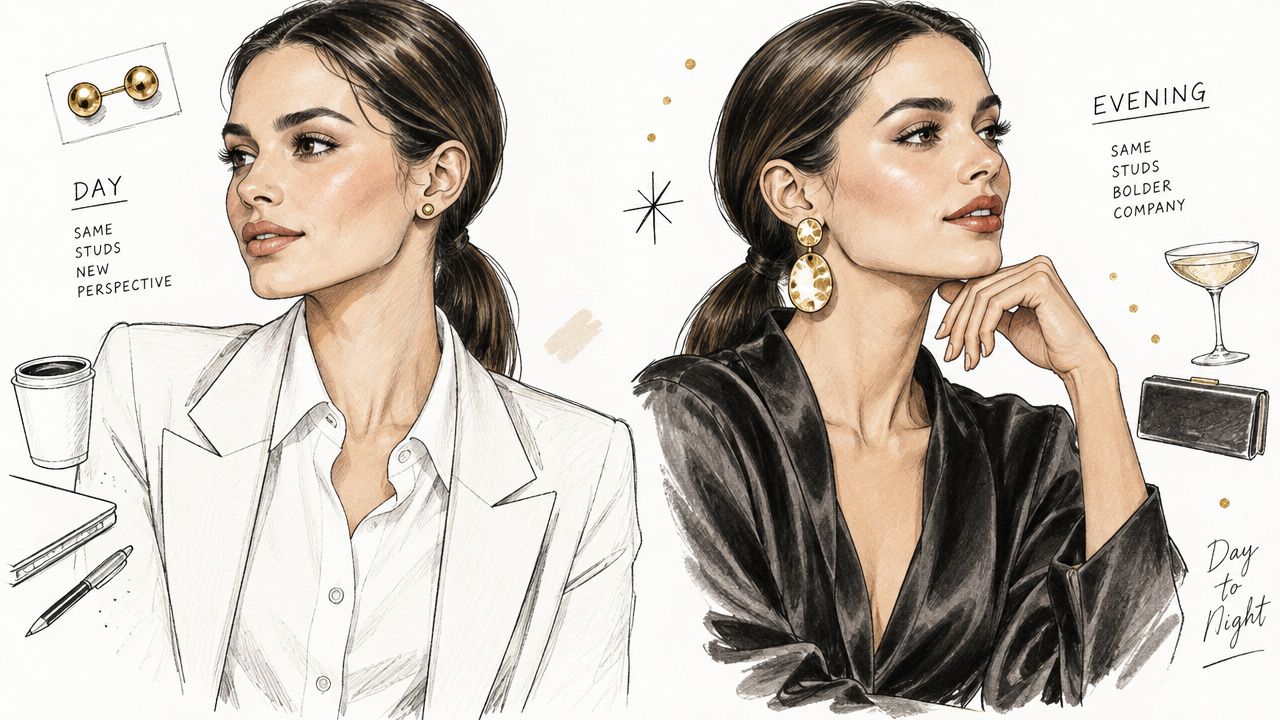
Gold studs become more useful when you stop assigning them to one dress code. The same pair can look casual with a crew-neck sweater, refined with a blazer, and intentionally minimal beside a formal neckline. Styling comes from proportion, texture, hair, and the other jewellery around them.
Build the day look first
For everyday dressing, pair a small yellow-gold ball or bezel stud with knitwear, denim, a simple top, or a coordinated set. The warm metal adds definition near the face without creating a formal effect. If your outfit already has a strong print or textured fabric, a plain stud gives the eye somewhere to rest.
At the office, a medium pearl, polished geometric shape, or discreet stone can work with a blazer, shirt, or fine sweater. Keep the rest of the jewellery close in scale. A slim chain and a restrained ring will support the earrings rather than competing with them.
Canadian trend coverage has highlighted layered gold pieces, dainty ear stacks, and mismatched earrings for 2025, making small studs especially useful as secondary-piercing pieces. The Canadian jewellery trend coverage reflects a move toward collections that can be combined instead of one fixed set.
A simple stack might place a tiny round stud in the upper lobe and a slightly larger bezel or pearl in the first piercing. For an intentionally mismatched look, keep one element consistent, such as the gold colour, the shape family, or the level of shine.
For an evening clutch, the earrings should support the outfit's finish rather than fight it. A small cluster can echo sparkle on a dress, while a smooth yellow-gold stud can balance a satin jumpsuit or a richly coloured blouse. If you're pairing jewellery with a special bag, these evening clutch styling ideas can help you coordinate shine and proportion.
The video below offers another visual reference for combining jewellery with changing outfits and occasions.
Mixing metals without losing control
Mixed metals can look deliberate when one tone acts as the anchor. Start with yellow-gold studs, then add a white-metal necklace or ring as the contrast. Repeat one detail, such as a geometric shape or smooth finish, so the combination feels connected.
You don't need a large collection. One practical pair, one small stacking pair, and one more decorative pair can cover casual, office, and formal dressing while leaving room for personal combinations.
Caring for Gold Stud Earrings and Keeping Sensitive Ears Happy
Gold studs last longer when you treat the posts and backings as carefully as the visible fronts. Remove them before workouts, swimming, and sleep when pressure, sweat, chlorine, or repeated movement could affect comfort or finish. Store each pair in a separate pouch or compartment so the fronts don't rub against harder jewellery.
A low-effort care routine
Use a small amount of mild soap and water for routine cleaning, then dry the earrings with a soft cloth. Don't scrub aggressively around a stone setting, and don't pull on the post to remove residue. For plated pieces, gentle handling matters because friction can wear the surface and reveal the base metal beneath.
- Daily: Wipe away moisture, skincare, and hair-product residue before storage.
- Weekly: Clean the fronts, posts, and backings gently, then dry them fully.
- Before travel: Use a separate pouch and close each backing so it doesn't scratch another piece.
- During storage: Keep earrings away from damp bathroom air and loose items that can bend posts.
A stud's backing can collect residue even when the front looks bright. Inspect the clutch for rough edges, looseness, or discoloration, and check that the post remains straight. If a setting catches on fabric or hair, stop wearing it until a jeweller checks the finish.
For another perspective on comparing everyday earring materials, see this guide to silver stud earrings, especially if you're deciding whether one metal should become your daily default.
Sensitive ears need material transparency
A reaction may appear as itching, redness, tenderness, swelling, or a rash around the piercing. Remove the earrings if irritation develops, avoid putting the pair back in while the skin is unsettled, and seek medical advice when symptoms are severe, persistent, or worsening.
Gold plating doesn't automatically solve sensitivity. A 2026 peer-reviewed study found that gold-plated earrings widely released nickel and often exceeded regulatory limits. The practical lesson is simple: ask about the post, the backing, the solder, and the core metal, not only the colour on the surface.
Canadian guidance often references EU nickel-release benchmarks of 0.2 µg/cm²/week for posts inserted into pierced ears and 0.5 µg/cm²/week for other prolonged skin-contact articles. Those figures appear in Canadian guidance for hypoallergenic jewellery gifts. Treat them as technical context, while remembering that your own skin response still deserves attention.
Finding Your Perfect Pair of Gold Stud Earrings at Fashion Bags and More
Choose your pair by asking four practical questions. First, will you wear it most days, for stacking, or for formal occasions? Second, do you prefer the harder feel of a lower-karat alloy or the richer colour and higher gold content of 18K? Third, do you need a specific backing for security, sleep, or comfort? Finally, have you confirmed the metal touching your piercing?
For a first pair, a modestly sized solid stud with a secure, smooth backing is a flexible choice. A second-piercing pair can be smaller and more graphic. A formal pair can add a pearl, bezel-set stone, or cluster front without changing the rest of your jewellery. If sensitivity is a concern, make the post and backing your first filter, then choose colour and shape.
The Canadian market offers plenty of variety, and national trade records show active movement of precious-metal jewellery through multiple retailers and provinces. That gives shoppers room to compare construction and styling rather than choosing only by appearance. Fashion, Bags & More's jewellery category includes earrings, necklaces, bracelets, and watches, with storefront browsing and CAD-denominated pricing for shoppers using the Canadian region setting. You can also compare a coordinated jewellery direction through a piece such as this square sail diamond-encrusted necklace.
A sensible wardrobe plan starts small. Select one pair for repeated wear, add a compact design for stacking, and reserve a more detailed pair for dinners, celebrations, or gifting. That approach gives you versatility without asking one earring to do every job.
Fashion, Bags & More offers earrings and other jewellery alongside clothing, footwear, handbags, and accessories, with CAD pricing and region options for Canadian shoppers. Visit Fashion, Bags & More to browse the jewellery collection and choose gold studs that fit your everyday routine, sensitive-ear needs, and personal styling system.