You're standing in front of the mirror, one strap keeps slipping, the band has crept up your back, and the panty edge is visible beneath your trousers. The set looked right online, but it doesn't feel right once you move, sit, bend, or pull on your favourite outfit. That frustration is common because bra and panties aren't sized or constructed like a single universal system.
A better approach treats lingerie like the foundation of an outfit. Fit determines whether your clothes sit smoothly, fabric affects how comfortable you'll feel through the day, and the cut should match the neckline, waistline, and movement your clothing requires. This guide builds those decisions in order, from style and support to measurements, materials, coordination, care, and online shopping.
For Canadian shoppers, intimate apparel is also a substantial retail category rather than a minor add-on. Women's lingerie, sleepwear, and underwear reached approximately CAD 650.91 million in Canadian retail sales in Q3 2023, according to Statista's Canadian market data. A thoughtful drawer can therefore be practical, personal, and organised around the way you dress.
Table of Contents
- Introduction to Bra and Panties as Everyday Essentials
- Understanding Bra and Panties Styles and How They Work
- How to Find Your Fit and Read Size Charts with Confidence
- Materials Comfort and Construction That Affect Daily Wear
- Matching Versus Mix and Match and Choosing for Body Type and Outfit
- Care Longevity and More Responsible Choices
- Smart Shopping on Fashion Bags and More and Final Takeaways
Introduction to Bra and Panties as Everyday Essentials
A bra and panty set can change the way a morning feels before you've chosen a shirt. A firm but comfortable band gives a bra a stable base, while the right panty rise stays in place instead of competing with your waistband. When those two pieces work, you notice the outfit. When they don't, you notice the underwear all day.
Think of a bra as the supporting structure and panties as the contact layer between your body and clothing. The supporting structure needs the right shape and tension. The contact layer needs softness, suitable coverage, and seams that behave well under fabric. Neither piece has to be elaborate to be useful, and neither should be selected by appearance alone.
Canada also has a long relationship with coordinated intimate apparel. The Canadian Wonderbra story began in Montreal in 1939, when Moe Nadler launched a lingerie company and acquired rights to the American Wonder-Bra design. Between 1939 and 1955, the company produced girdles, swimsuits, slips, panties, and bras, and by the end of the 1970s, Wonderbra sales had grown into a CAD 27-million business, as documented by The Globe and Mail's history of Wonderbra in Canada.
Practical rule: Choose lingerie for the clothes and activities you'll wear it with, not for the product photo alone.
A useful first purchase separates the decision into four questions:
- What support do I need? Consider everyday movement, work, lounging, or exercise.
- How much coverage feels comfortable? Coverage is a preference, not a body-type rule.
- What will I wear over it? Smooth cups and flat edges behave differently from lace or textured details.
- How will I care for it? Fibre content and elastic construction affect washing and drying.
Fashion, Bags & More places lingerie alongside clothing, sleepwear, footwear, bags, and accessories, which can make outfit planning more connected. The important outcome isn't buying more pieces. It's building a smaller, more predictable rotation of bras and panties that fit, feel comfortable, and suit the clothing already in your wardrobe.
Understanding Bra and Panties Styles and How They Work
Bra names describe the shape, coverage, and visual effect of a garment. Panty names describe the amount of coverage, rise, and where the leg opening sits. Once you understand those three ideas, unfamiliar labels become easier to decode.
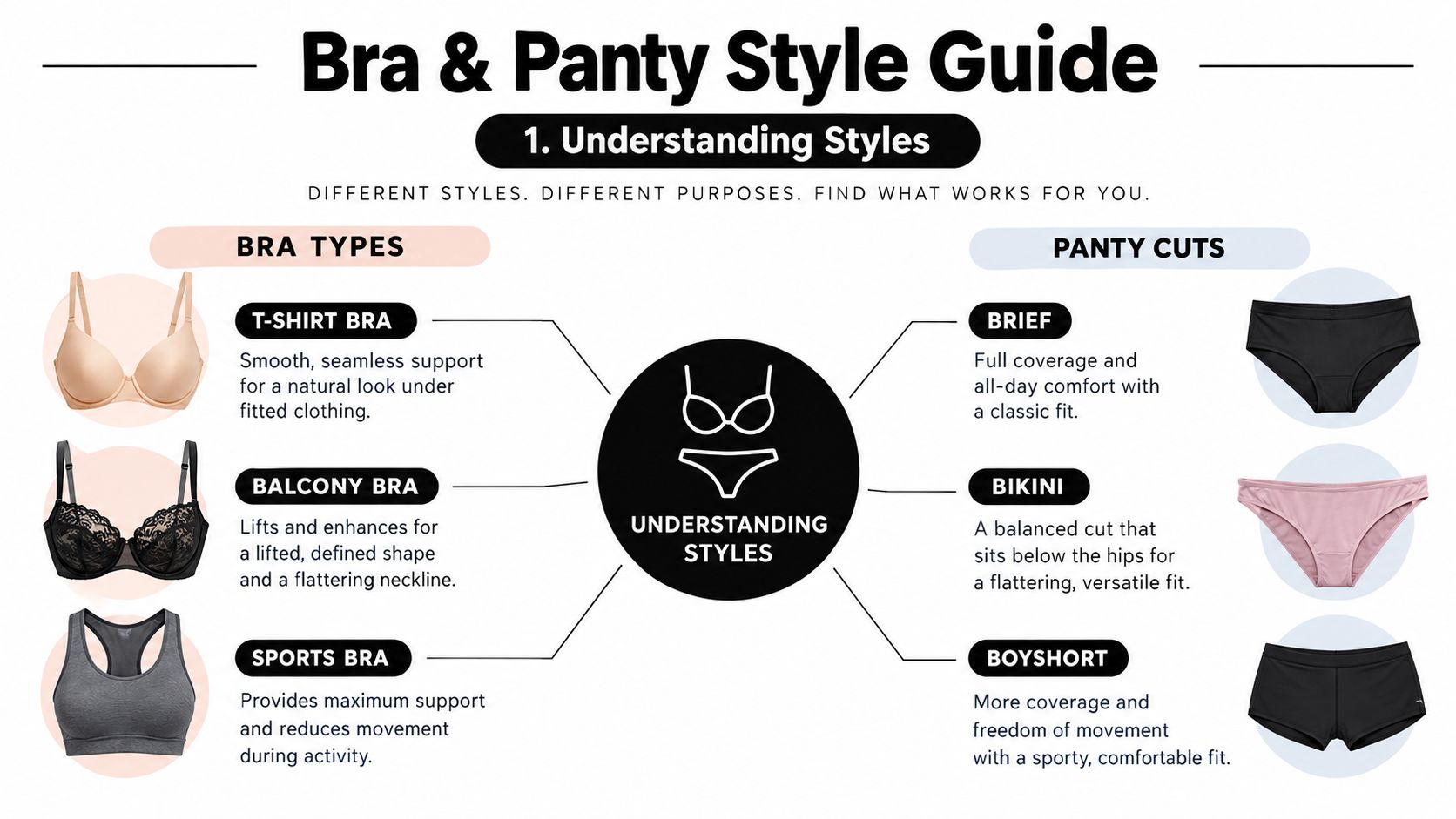
Bra shapes from support to styling
A T-shirt bra uses smooth cups and relatively unobtrusive seams to create a clean surface under close-fitting tops. It's often a reliable starting point for work shirts, knit dresses, and lightweight fabrics because the bra is designed to disappear visually.
A balconette or balcony bra has a lower, more horizontal neckline and usually places the straps farther apart. It can complement square or wider necklines, although the fit must keep the bust securely contained at the top and sides.
A push-up bra uses padding, angled cups, or construction that brings the bust inward and upward. It makes sense when you want more shaping under an occasion outfit, but it shouldn't be used to compensate for a cup or band that doesn't fit.
A bralette generally offers a softer structure, often without an underwire. It may suit low-impact days, layering, sleepwear, or anyone who prefers flexible comfort over firm shaping.
A sports bra is built around movement. Its compression or encapsulation construction aims to reduce bounce and keep the bust stable during activity. Choose it according to the intensity and motion of the activity, not just because it looks supportive.
Panty cuts as coverage choices
A brief provides fuller front and back coverage, often with a more secure feel under everyday clothing. A bikini sits lower on the hips with moderate coverage and works well with mid-rise bottoms. A hipster generally sits across the hip bones and has a wider side panel, making it a practical bridge between a brief and a bikini.
A boyshort extends farther down the leg and can feel comfortable beneath relaxed clothing or sleepwear. A thong minimises fabric across the back, which can reduce visible lines under fitted trousers or skirts. A G-string uses even less material and a narrower construction, so the quality of the edge, fabric, and fit becomes especially important.
Coordinated sets and separates
A coordinated set creates a finished visual effect through shared colour, fabric, or detailing. Separates let you combine a supportive bra with a different panty cut, which is often more useful when your body proportions, coverage preferences, or outfit requirements vary.
Use the foundation analogy: the bra establishes support and shape, while the panty is the finishing layer that determines how the lower half of an outfit sits. A lace set may suit a special occasion, a smooth T-shirt bra may solve a daily clothing problem, and a cotton brief may be the better choice for a long day at home. The right style is the one that performs its intended job without demanding constant adjustment.
How to Find Your Fit and Read Size Charts with Confidence
Brand-to-brand sizing can make online lingerie shopping feel like guesswork. The safest method is to treat every size chart as a new set of instructions, even if you already know the size you usually wear. A familiar label is a starting point, not proof of fit.
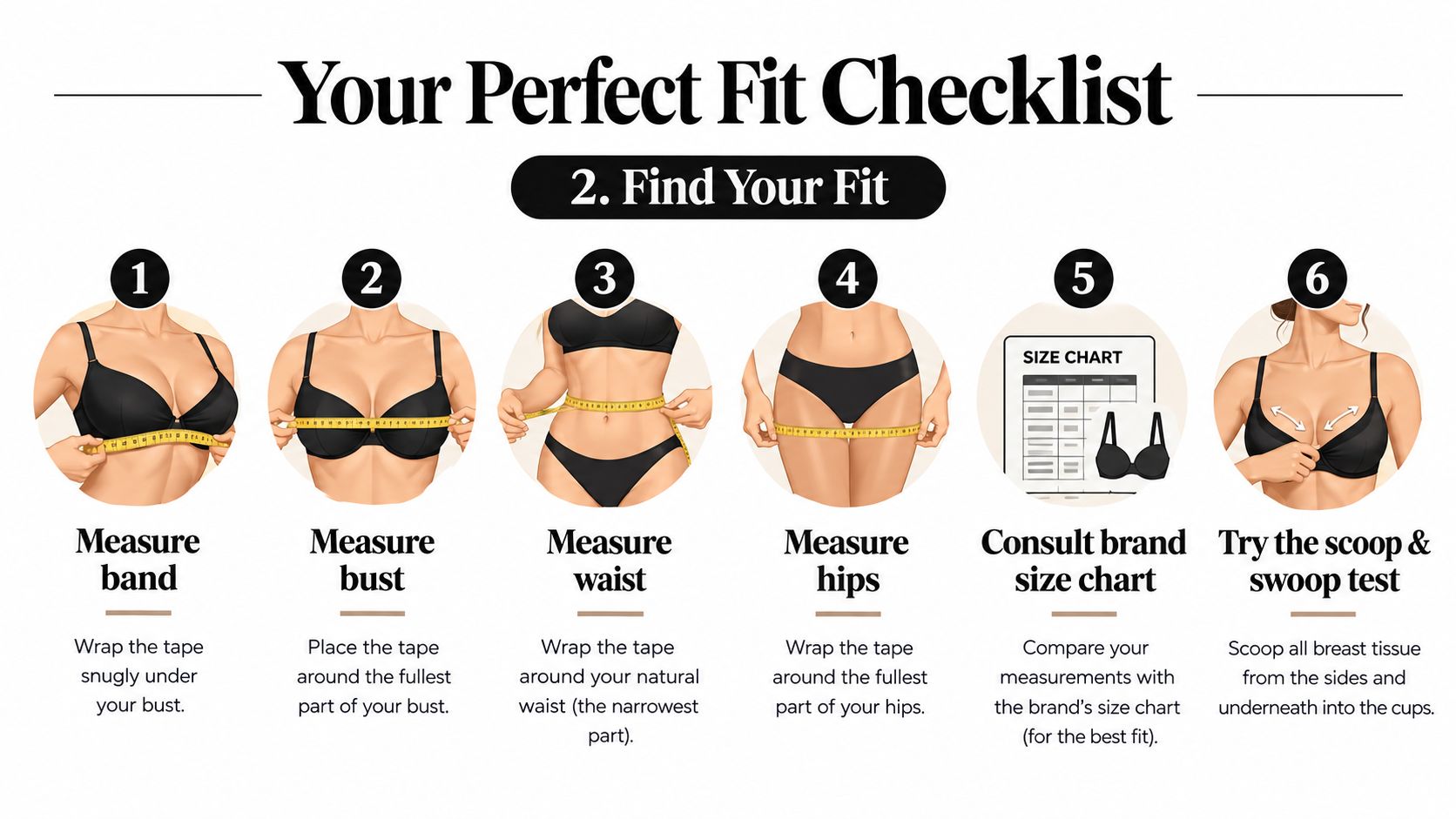
Take measurements that reflect the garment
Wear a lightly lined bra, or measure without a bra if that gives a more natural result. Keep the tape level and snug, but don't pull it tight enough to compress the body.
- Measure the band area. Wrap the tape around your ribcage directly beneath the bust. This measurement helps you understand the base the bra band needs to sit on.
- Measure the fullest part of the bust. Keep the tape level across the back and fullest point without flattening the bust.
- Measure your waist. Find the area where your body naturally narrows. This helps with higher-rise panties and shapewear.
- Measure your hips. Use the fullest area around the hips and seat. Panties need this measurement more than a bra size label.
- Compare each measurement with the product chart. Don't assume a medium in one cut equals a medium in another.
- Check the garment's intended rise and stretch. A low-rise G-string, a high-waist brief, and a cotton stretch panty can sit very differently even when their labels match.
For a visual walkthrough, use this lingerie bra fitting guide, then compare the chart on the exact product page you're considering.
Read the fit clues, not just the number
Put the bra on using the loosest hook at first. Lean forward slightly, place the breast tissue fully into the cups, and adjust the straps after the band is positioned. This is often called the scoop and swoop method, and it helps reveal whether the cups are containing the bust.
A good bra band stays level across the back and feels secure without restricting breathing. The cups should lie smoothly, the centre panel should rest against the breastbone when the design allows it, and the underwire should surround the breast rather than sit on tissue.
Use these clues to troubleshoot:
- Cup spillage or an underwire pressing at the side: Try a larger cup, or a different cup shape.
- A band riding upward: Try a smaller band, then consider a larger cup if the current cup becomes too small.
- A wrinkled or gaping cup with a comfortable band: Try a smaller cup or a different style with less space at the top.
- A tight band with cups that look correct: Try a larger band with a smaller cup to preserve a similar volume.
- Panties rolling or cutting in: Try a different rise, a wider side panel, or a larger size.
- Panties shifting while you walk: Check the hip measurement and consider whether the cut is too narrow for your preferred coverage.
Fit check: If you keep adjusting a garment every few minutes, the problem may be the style rather than your body.
The bra and panties size guide video can support your measuring routine, but the final decision should still include the specific product chart, fabric composition, and return conditions.
Materials Comfort and Construction That Affect Daily Wear
Fabric decides how a garment feels against the skin, while construction decides how it behaves during movement. Two panties can share the same size but feel completely different because one uses a soft cotton gusset and broad edges, while the other relies on narrow elastic and smooth synthetic fabric.
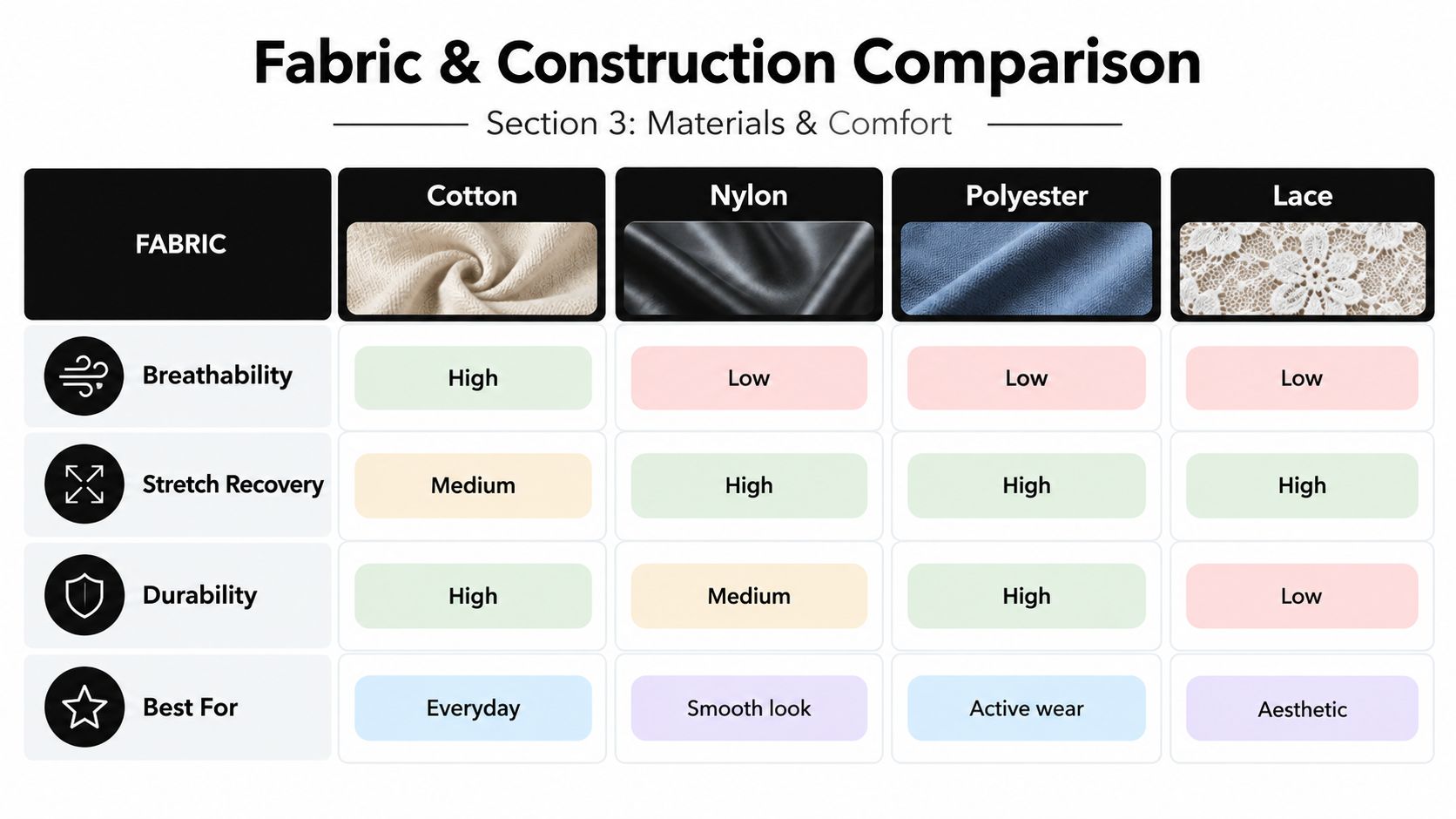
Compare fibres by the job they perform
Cotton is a familiar choice for everyday underwear because it feels soft and breathable. It may have less recovery than a highly elastic synthetic blend, so the fit depends on the weave and added stretch fibres.
Nylon often creates a smooth, light finish with useful stretch and recovery. It can work well beneath fitted clothes, although it may feel less airy than cotton for some wearers.
Polyester can offer durability and shape retention, particularly in active or decorative pieces. Its feel depends heavily on the weave, finish, lining, and blend rather than the fibre name alone.
Lace changes the look and texture of lingerie. It can be soft and flexible, but raised patterns, narrow edges, or rough seams may become noticeable under delicate clothing or during long wear.
The fibre label deserves attention in Canada. The Competition Bureau's textile labelling requirements require undergarments such as bras and panties to disclose fibre content using generic fibre names, and fibres making up 5% or more of the total mass must be listed with their percentage. That information helps you connect material choice with stretch, moisture handling, wash care, and durability.
Construction can matter more than the fabric name
Look at the waistband, leg openings, gusset, seams, hooks, and strap adjusters. A wide waistband may distribute pressure more comfortably than a narrow one. A bonded edge can reduce visible lines, while a conventional stitched edge may offer a more familiar, flexible feel.
For an everyday option, inspect the seamless cotton brief design for its rise, fibre details, and construction before ordering. Don't rely on the word “seamless” alone. It may refer to the body of the garment while the waistband or gusset still has seams.
Before keeping a set, bend, sit, raise your arms, and walk. The best material is the one that remains comfortable through those movements and can be washed according to the care instructions you're prepared to follow.
Matching Versus Mix and Match and Choosing for Body Type and Outfit
“Dressing for your body type” works better when it means choosing proportion and support, not following rigid rules. A fuller bust may call for deeper cups or wider straps, while a preference for more lower-body coverage may point towards a brief, hipster, or boyshort. A smaller bust may suit a bralette or triangle shape, but comfort and personal style still lead the decision.
Start with the outfit. A smooth bra is usually easier beneath a fitted T-shirt than textured lace. A low-rise panty may work with low-rise trousers, while a high-waist style can align more naturally with a high-waisted skirt. Under a clingy dress, consider flat edges and minimal seams. Under a loose jumper, you have more freedom to choose texture, trim, or coverage.
Match the set to the situation
| Decision Factor | Coordinated Set | Mix and Match Separates |
|---|---|---|
| Visual finish | Shared colour and detailing create a polished look | Different pieces can still look intentional through colour or texture |
| Fit flexibility | Useful when the bra and panty proportions suit you together | Better when your preferred bra and panty sizes or cuts differ |
| Outfit planning | Simple choice for occasions and gift dressing | Easier to adapt across workwear, casual clothing, and sleepwear |
| Coverage | The included panty may not match your preferred rise | You can pair a supportive bra with a brief, bikini, or thong |
| Shopping effort | Fewer styling decisions | More control over fabric, seams, and comfort |
A single black T-shirt bra can work with a cotton brief for an ordinary day, a smooth bikini beneath trousers, or a minimal panty beneath a fitted evening outfit. The colour creates continuity, while the cut changes according to the clothing.
For a higher-rise, smoothing layer beneath a fitted outfit, review the construction and coverage of high-waist tummy-control panties. Shapewear should feel supportive rather than restrictive, and it must be sized according to the product chart instead of chosen smaller for extra control.
Style principle: Let the outfit decide the edge, the activity decide the support, and your comfort decide the final cut.
A coordinated set is convenient when the fit works as a pair. Mix and match is more practical when your body, wardrobe, or daily plans require different solutions. Neither choice is more correct.
Care Longevity and More Responsible Choices
Good lingerie care starts with the label, not a generic laundry habit. Fibre blends, lace, elastics, hooks, and bonded edges can respond differently to heat and agitation. If you want a bra or panty to retain its shape, treat the garment according to its construction.
Use a simple care routine
- Separate delicate items: Keep bras away from rough zippers, hooks, and heavy denim.
- Close bra hooks: Fastening them reduces the chance that hooks catch lace or stretch fabrics.
- Choose gentle washing: A delicate cycle or hand washing can reduce stress on elastic and trim.
- Avoid high heat: Air drying is generally kinder to stretch fibres than a hot dryer.
- Store bras carefully: Stack moulded cups rather than folding one cup into the other.
- Rotate frequently worn pieces: Resting elastic between wears can help garments keep their intended shape.
The sustainability decision also includes what happens after purchase. Canadian consumer research reports that 62% of Canadians are willing to pay a premium of 20% or more for sustainably produced goods and services, according to Deloitte's consumer sustainability report. The same source notes that clothing take-back programs are limited in Canada, and there are no national or provincial extended producer responsibility programs for textile and apparel products.
That makes garment life especially important. Choose pieces you'll wear repeatedly, check fibre composition before ordering, and favour a dependable fit over impulse purchases. Responsible buying doesn't require every item to be expensive or perfect. It means reducing avoidable returns, caring for what you keep, and replacing pieces because they're worn out rather than because they never worked in the first place.
Smart Shopping on Fashion Bags and More and Final Takeaways
A predictable online purchase follows a short sequence. Search by garment type first, narrow by style or collection, then read the size chart and material details before looking at colour. Product pages can show the difference between a smooth brief, a lace G-string, a bralette, or a coordinated set, but the photograph won't replace measurements.
Check the region selector before checkout if you're shopping from Canada, the United States, or the United Kingdom. Review the displayed currency, shipping information, refund terms, and product-specific conditions, particularly for intimate apparel. These details matter when fit varies between styles and when hygiene conditions may affect returns.
A listing such as the 3Pcs Set Sexy Lace G-String illustrates why construction details deserve attention. Its description identifies a low-rise G-string design with lace decoration and synthetic materials, so a shopper should compare the rise and fibre information with their intended outfit and comfort preferences rather than judging the set only by its appearance.
Use this final check before ordering:
- Fit: Measure the band, bust, waist, and hips, then use the exact product chart.
- Style: Match support and coverage to your movement and clothing.
- Fabric: Review fibre percentages, stretch, lining, and care instructions.
- Construction: Inspect seams, edges, gussets, straps, closures, and rise.
- Policy: Confirm shipping and refund information before payment.
- Care: Decide whether you can wash and dry the piece as recommended.
With those checks, bra and panties become easier to buy across brands and less likely to create an uncomfortable drawer full of “almost right” pieces.
Fashion, Bags & More offers bras, panties, coordinated lingerie, sleepwear, and wider outfit categories through an online catalogue with CAD pricing and region selection for Canada, the United States, and the United Kingdom. Visit Fashion, Bags & More to compare styles, check product details, and build a lingerie rotation around your fit, fabric, and wardrobe needs.