You've got ten minutes to leave, and three pairs of black heels are staring back from the wardrobe. One has the height, one looks comfortable, and one somehow makes the outfit feel polished without trying too hard. Reaching for the newest pair is tempting, but a black heel isn't a universal shoe. Its toe shape, heel structure, finish, and height decide whether it belongs in a boardroom, on a pavement, or beside a dance floor.
The right talon haut noir should earn its place through real use, not just a dramatic mirror moment. Canada's footwear market generated USD 8,576.4 million in revenue in 2024 and is projected to reach USD 10,906.8 million by 2030, with non-athletic footwear accounting for 67.32% of 2024 revenue, according to the Bata Shoe Museum's footwear market overview. That broad category is where dress shoes, pumps, and fashion heels live, so the opportunity is obvious. The smarter question is which black heel deserves your money.
Table of Contents
- The Black Heel Decision Most Shoppers Get Wrong
- The Five Silhouettes Every Black Heel Collection Needs
- How Heel Height Changes the Whole Experience
- Matching Black Heels to Real Outfits and Occasions
- Comfort Features That Matter in a Black Heel
- Building a Two-Pair Black Heel Capsule
- Fit Sizing and Care for Long-Term Wear
- Quick Answers About Black Heels You Can Wear Again
The Black Heel Decision Most Shoppers Get Wrong
A woman choosing shoes before dinner usually starts with the dress. That's backwards. She should start with the ground she'll walk on, the distance she'll cover, and the impression she wants the shoe to create.
The pointed pump may look perfect with a fitted trouser suit, but it can feel too formal with relaxed denim. The stiletto may flatter a slip dress, yet become a liability at an outdoor reception. A low block heel might look modest in the box, then become the pair she reaches for every week because it survives pavement, stairs, and standing.
The two-second rule: choose the occasion first, then the silhouette, then the height.
Black heels became associated with formality and status through a long fashion history. High heels originated in Western Asia as riding footwear before European adoption at the end of the 16th century. During the 17th century, men, women, and children wore them as signs of wealth and style. The Bata Shoe Museum's history of high heels also records that, under Louis XIV, red heels carried political meaning because only people admitted to the French court could wear them.
That legacy still explains why a black pump can make an outfit feel authoritative without adding colour. But heritage doesn't make every shape useful. A wardrobe needs shoes assigned to jobs.
A faster way to choose
- Commuting: choose a low block heel, kitten heel, or ankle boot. You need stability and a secure foot.
- Boardroom: choose a pointed pump with a restrained heel. It sharpens tailoring without competing with it.
- Wedding guest dressing: choose a block-heel sandal or platform when standing and uneven ground are involved.
- Evening drama: choose a stiletto with a dress that does the rest of the talking.
- Long daytime plans: choose a kitten heel, especially with cropped denim or a simple dress.
The mistake is buying the tallest or most fashionable pair first. Buy the silhouette that solves your most frequent occasion, then add drama once your practical gap is covered.
The Five Silhouettes Every Black Heel Collection Needs
A useful collection doesn't need every trend. It needs five recognisable shapes, each with a distinct purpose. Think of them as wardrobe tools rather than interchangeable black accessories.
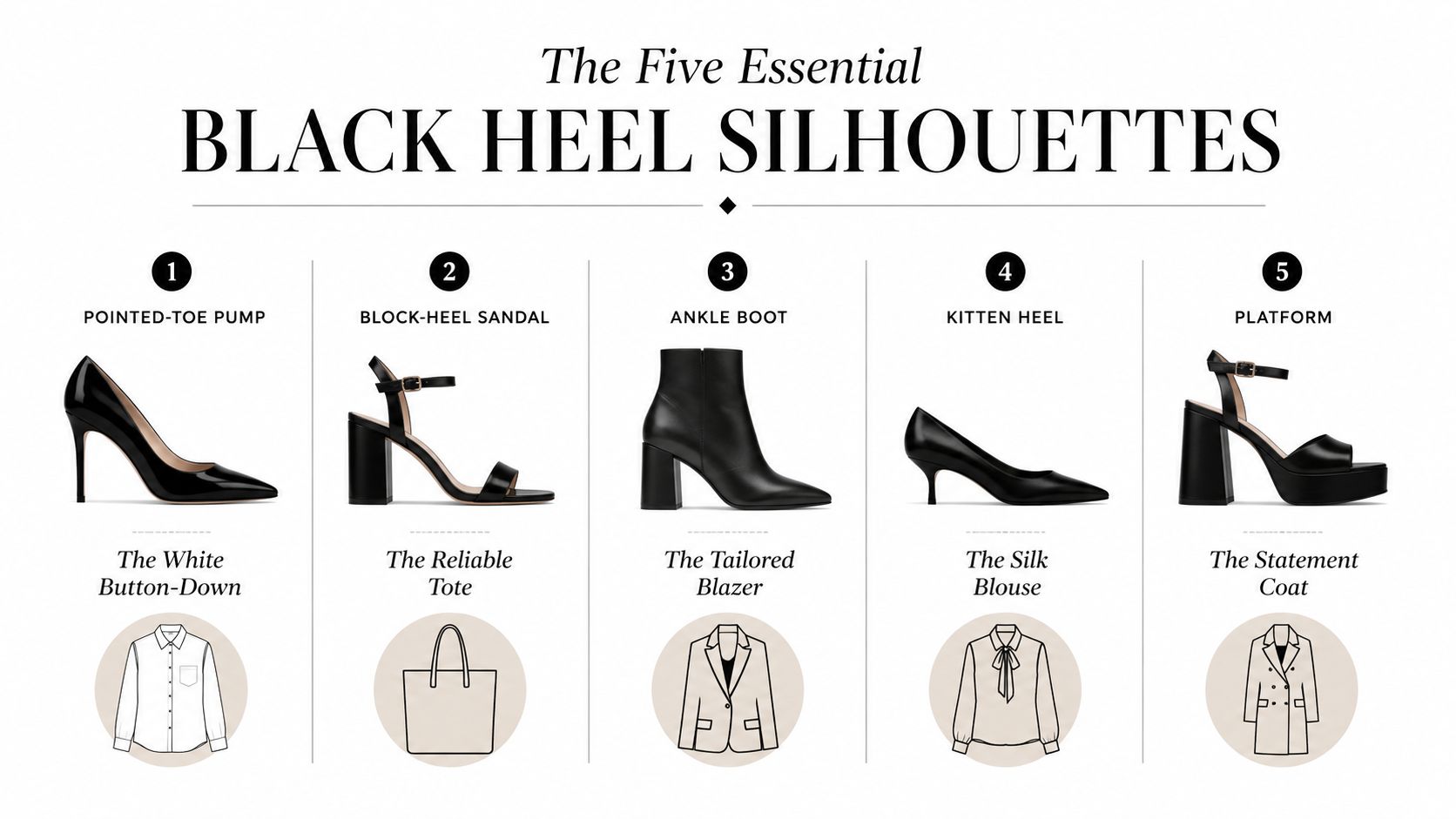
The pointed-toe pump
This is the white button-down of dress shoes. Its tapered toe and clean upper look sharp under trousers, pencil skirts, and structured dresses. It visually lengthens the foot and makes formal clothing feel deliberate.
Spot it on a rack by looking for a closed toe that narrows toward the front and a simple vamp without heavy decoration. Choose matte leather for daily wear. Patent adds evening polish but can look severe under bright office lighting.
The block-heel sandal
Treat this as the reliable tote of the group. A wider heel gives you a more stable base, while an open upper keeps the shoe lighter for warm-weather dressing. It's the correct choice for a summer wedding, garden party, or any venue where a thin heel would sink into grass.
Look for a square or rounded block beneath the rear of the shoe, plus adjustable straps that hold the midfoot. A sandal with a secure ankle strap is far more useful than a slip-on that forces your toes to grip.
The ankle boot
The ankle boot is the structured blazer. It adds shape, works across seasons, and makes dresses, denim, and trousers look more intentional. A slim shaft under a knit dress feels sleek, while a slightly broader shape gives straight-leg jeans a modern finish.
On the rack, identify the boot shaft first. The heel can vary, but the ankle coverage is what separates it from a pump or sandal. Choose a clean black leather or suede upper if you want maximum outfit range.
The kitten heel
This is a silk blouse with practical manners. It gives you lift without forcing a dramatic stride, so it suits offices, brunch, gallery visits, and days when you're moving between locations. A pointed kitten heel feels refined, while a slingback version looks lighter and more relaxed.
Find it by the short, narrow heel that rises neatly from the back of the shoe. Don't dismiss it as old-fashioned. With cropped jeans, a midi skirt, or a simple trouser, it gives an outfit a polished finish without looking overworked.
The platform pump
The platform is the statement coat of footwear. It delivers height and visual impact, but the raised front can reduce the angle between your heel and forefoot compared with a similarly tall shoe without a platform. That makes it the strongest candidate for dancing, parties, and seated evening occasions.
Look for a noticeable sole beneath the forefoot, not merely a tall heel. For a dramatic bow-detail option, compare this platform chunky black heel sandal.
How Heel Height Changes the Whole Experience
Heel height changes more than your posture. It alters your stride, shifts your weight forward, and changes how much work your toes and forefoot must do to keep you stable.
A controlled study of formal pumps at 10, 30, 55, and 80 mm found that higher heels significantly increased pressure on the inside of the forefoot while reducing pressure on the outside. The study summary and formal black pump reference also notes that forefoot stress associated with callus formation was minimal at 30 mm, making that height a sensible target for comfort-focused dress shoes.
Use height as a mileage decision
Under two inches belongs to commuting, errands, and walking-heavy days. The lift is visible, but you won't need to negotiate every pavement crack or staircase.
Between two and three inches is the practical sweet spot for office dressing, dinners, and events where you'll stand for a while. Around three inches, the silhouette still feels elegant, but a block heel or platform can make the shoe much more forgiving than a narrow heel.
Three to four inches creates stronger presence. Choose it for dinners, parties, and photographs where the shoe matters more than distance. Above four inches belongs to short wear, seated occasions, and carefully controlled floors. If you're already shortening your stride, gripping with your toes, or leaning forward, you've crossed from wearing the heel to compensating for it.
| Height Range | Best Occasion | Comfort Level | Max Wear Time |
|---|---|---|---|
| Under two inches | Commute, errands, walking days | Highest for most wearers | Extended daytime use |
| Two to three inches | Office, dinner, indoor events | Strong balance of polish and ease | Long workday or evening |
| Three to four inches | Parties, dinners, photographs | Moderate, shape-dependent | Several hours with breaks |
| Above four inches | Seated events and short appearances | Low for extended movement | Short, planned wear |
A lower heel isn't automatically comfortable, and a tall heel isn't automatically impossible. Toe shape, forefoot width, cushioning, and heel stability decide how the height behaves. For a closer look at a low-lift alternative, see this guide to kitten heels and pointed toes.
Matching Black Heels to Real Outfits and Occasions
Start with the silhouette, not the hemline. Once the shoe shape matches the setting, heel height becomes an easy adjustment.
For a client meeting, wear a pointed pump under well-fitted trousers. The narrow toe echoes the clean line of the trouser leg, and the closed upper looks more authoritative than a chunky sandal. Choose black-on-black when you want a formal, uninterrupted effect. If your outfit is cream, cobalt, emerald, or another jewel tone, black creates a crisp anchor.
A block-heel sandal earns its place at a summer wedding with a midi dress. The broader heel handles outdoor surfaces better than a stiletto, and an ankle strap keeps the foot secure while you move between ceremony, photographs, and reception. Pair it with a dress in cream, soft print, or saturated colour, then let the black shoe define the accessories.
The stiletto belongs with a slip dress or sharply cut evening outfit. It works because both pieces carry sensual, elongated lines. Keep the rest of the styling controlled. A sleek shoe already supplies enough drama.
For daytime brunch, wear a kitten heel with cropped jeans and a soft blouse. The exposed ankle keeps the outfit fresh, while the small heel stops denim from looking overly casual. An ankle boot is the better answer under a knit dress in transitional weather, especially when you want coverage without giving up a shaped silhouette.
| Silhouette | Best Outfits | Ideal Occasions |
|---|---|---|
| Pointed pump | Tailored trousers, pencil skirt, structured dress | Client meetings, interviews, boardroom lunches |
| Block-heel sandal | Midi dress, wide-leg trousers, occasion separates | Summer weddings, outdoor receptions |
| Stiletto | Slip dress, evening tailoring, sleek jumpsuit | Cocktail events, dinners, parties |
| Kitten heel | Cropped jeans, midi skirt, refined day dress | Brunch, office, gallery visits |
| Ankle boot | Knit dress, straight-leg denim, trousers | Transitional weather, weekend dressing |
A pointed pump outperforms a chunky heel at a boardroom lunch because it reinforces tailoring. The chunky heel wins on grass because its base spreads the load instead of concentrating it on a narrow point. For a more overt evening option, browse these satin stiletto black heels.
Comfort Features That Matter in a Black Heel
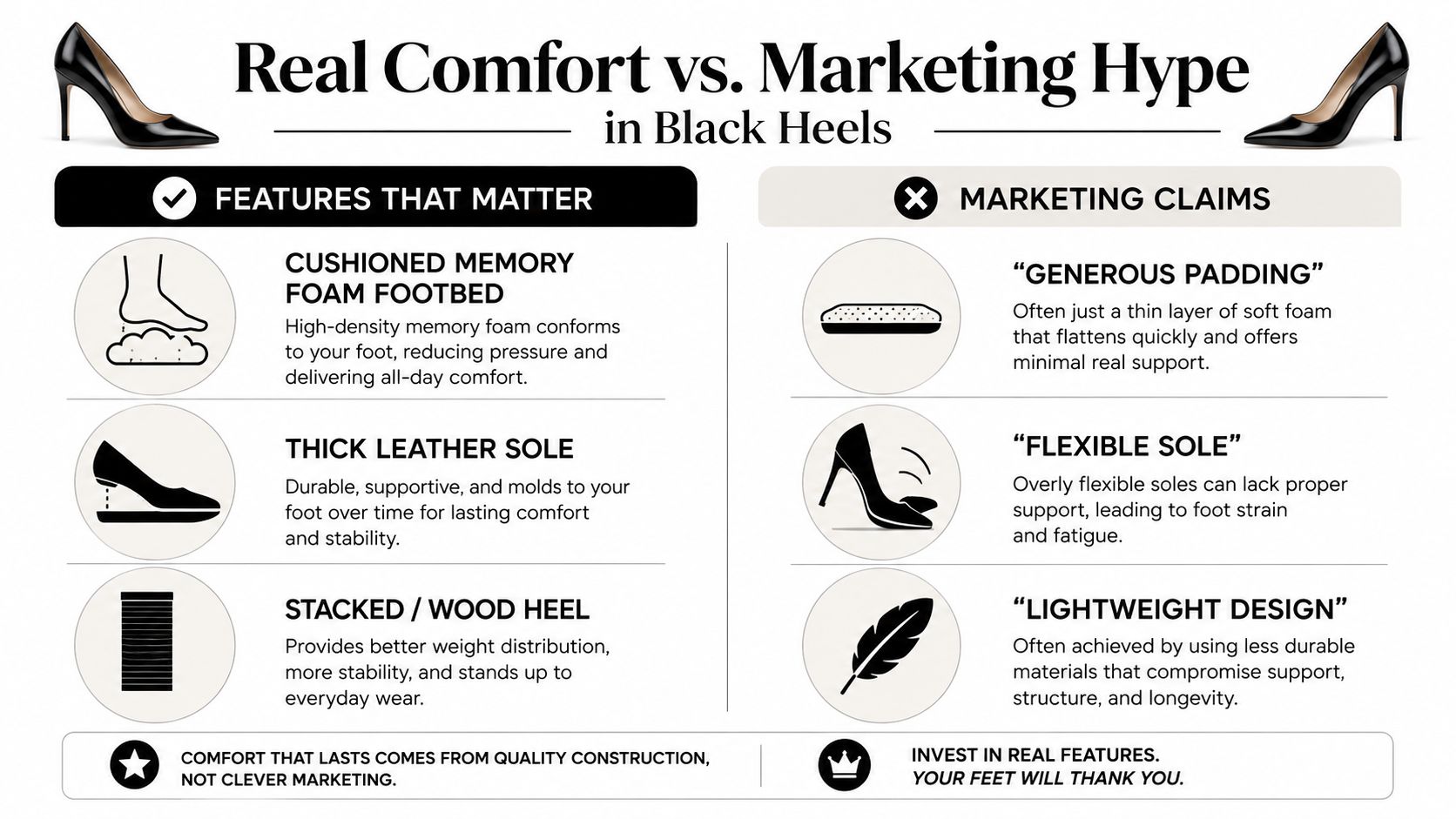
Marketing language cannot replace a fitting test. A shoe may promise generous padding yet overload the forefoot when its pitch, toe box, or upper works against your foot. For commuting, office hours, or a full evening out, construction matters more than the label.
Start with the footbed. Press the insole with your thumb. If it feels like a thin layer over a hard base, do not expect it to carry you through a long event. Cushioning helps when it supports a stable shape. A leather-lined interior usually feels smoother and handles friction better than a rough, unlined finish.
Compare the construction, not the slogan
- Footbed versus thin sole: cushioning softens contact, while a supportive footbed and stable base provide control beyond softness alone.
- Stacked heel versus synthetic heel: a stacked or solid heel often feels more planted and distributes force with greater confidence than a narrow, hollow-feeling heel.
- Ankle strap versus slip-on: a strap limits movement and reduces the need to grip with your toes.
- Platform versus pure height: a platform can reduce the foot angle, making a tall shoe easier to manage.
- Leather lining versus exposed interior: lining limits abrasive contact and gives the upper a smoother finish.
A chunky block spreads pressure across a wider base. A platform changes the relationship between heel height and forefoot pitch. For an office pump, choose a stable base and secure upper before chasing extra height. For a dance floor, skip any pair that makes you grip with your toes.
The two-minute fitting-room test
Bend the shoe gently at the toe. It should flex where your foot bends, not collapse through the middle. Press the forefoot and check that your toes can spread rather than being forced into a narrow wedge.
Walk, stop, and turn. Your heel should not lift dramatically, and the strap should not dig as your foot moves. Skip decorative buckles placed on pressure points, glossy coatings that look likely to crack at flex areas, and any shoe that feels uncomfortable before you leave the store. A black heel that needs “breaking in” from obvious pain is the wrong purchase.
Building a Two-Pair Black Heel Capsule
Four random pairs won't beat two deliberate ones. The first should be a mid-height pointed pump in matte black leather. It handles interviews, office meetings, dinners, fitted trousers, and dresses without looking tied to one season.
The second should be either a low block-heel sandal or a low ankle boot. Choose the sandal if your wardrobe leans toward dresses and warm-weather events. Choose the boot if you wear denim, knit dresses, and trousers through changing Canadian seasons.
Why the capsule works
The pump carries formal and evening outfits. The sandal or boot handles casual dressing, travel, and surfaces where a narrow heel makes no sense. A wedding guest outfit can use either pair, depending on the venue and dress length.
Material choice keeps the rotation flexible. Matte leather is the daytime workhorse. Patent or suede adds a stronger evening note, but true black in either finish still pairs with denim, cream, tailoring, and jewel tones.
The budget compromise should be decoration, not fit. Skip oversized hardware, elaborate trims, and fragile surface treatments before sacrificing a supportive footbed, secure heel counter, or correctly shaped toe box.
This capsule also creates a practical wear cycle. Rotate the two pairs so each can air out fully before the next outing. Once both shoes prove useful, upgrade the pair you wear most often, usually the pump, with better lining, outsole construction, and professional sole protection.
Fit Sizing and Care for Long-Term Wear
A beautiful black heel that doesn't fit is an expensive mistake. Measure both feet in the evening, when feet have had time to swell, and use the larger measurement when choosing a closed shoe.
Canadian shoppers should compare more than the printed size. One Canada-based chart maps women's US/Canada sizes from 4 to 12 to approximately 20.8 cm to 27.6 cm of foot length, with half-size changes around 0.3 to 0.4 cm, as shown by Globo Shoes' Canadian black heel listings and size guidance. Use centimetres alongside the brand's Canada/U.S., EU, and UK conversion. Small length errors become more noticeable when the heel pushes the foot forward.
Fit checks before the first outing
- Toe room: leave approximately a thumb's width in a closed pump, without allowing the foot to slide forward.
- Heel grip: walk firmly and check whether the heel lifts excessively.
- Width: look for width-specific options rather than forcing a narrow pointed shoe over a broad forefoot.
- Strap tension: fasten ankle straps securely, but make sure they don't leave deep pressure marks.
- Break-in: wear thick socks indoors and use gentle warmth on tight leather areas. Stop if the material feels overheated.
Care keeps the upper wearable, but different finishes need different treatment. Condition smooth leather with a neutral balm periodically. Store shoes with cedar trees or rolled magazine tubes to preserve the vamp shape, use a dedicated brush on suede, and treat patent leather carefully rather than scrubbing it.
A cobbler can add rubber half-soles to protect the front of a dress shoe. Check heel tips monthly for looseness, inspect stitching, and remove grit before it cuts into the sole. Catching a small defect early costs less frustration than repairing a shoe after the heel has become unstable.
Quick Answers About Black Heels You Can Wear Again
Is black patent the same as black matte leather? No. Patent reflects bright light and reads more formal or evening-focused, while matte leather looks quieter and more adaptable during the day. Match the finish to the event instead of treating every black shoe as interchangeable.
What heel works for all-day wear? A block heel around three inches is the sweet spot for many wearers because it combines visible lift with a broader base. The exact result still depends on fit, toe shape, cushioning, and how much walking the day includes.
Should you avoid stilettos above four inches? Reserve them for short events, photographs, and seated occasions, particularly when the floor is firm and even. They aren't the right choice for long pavement walks or outdoor receptions.
Do pointed toes make feet look longer? Yes, visually, but they can pinch wider feet. An almond toe gives a similar elongated effect with a more forgiving front.
Can satin or suede survive water? Water damage can be permanent on both finishes. Protect them before wear and avoid wearing them when the forecast or venue makes splashing likely.
Is resoling worthwhile? For a quality upper, resoling can be more sensible than replacing the entire shoe. A cobbler can also add protective rubber to extend practical wear.
Finally, rotate your two dependable pairs. Letting each shoe dry fully between wears helps the materials recover and keeps your everyday black heel capsule in use rather than forcing one pair to carry every occasion.
Fashion, Bags & More offers women's heels alongside dresses, handbags, jewellery, and other accessories, with collections priced in CAD and shopping options for Canada, the United States, and the United Kingdom. Visit Fashion, Bags & More to compare black heel styles and build the two-pair capsule that fits your wardrobe and your real schedule.