You're standing in front of a wardrobe full of black trousers, dark denim, camel knits, and sensible winter coats, yet the outfit still looks unfinished. A pair of red boots could solve the problem in seconds, but you hesitate because they seem too loud, too seasonal, or too difficult to repeat.
That hesitation is understandable, but it's based on an outdated idea of red footwear. The right pair of women's red boots doesn't behave like a costume accessory. It works as a colour anchor, adding focus to simple outfits while remaining surprisingly compatible with the neutrals already in your wardrobe.
Table of Contents
- Why Red Boots Deserve a Spot in Your Winter Wardrobe
- Choosing the Right Shade of Red for Your Style
- Matching Materials to Canadian Weather Conditions
- Building Outfits Around a Statement Boot
- Selecting the Best Silhouette for Your Proportions
- Evaluating Cost Per Wear and Long Term Value
- Stepping Out With Confidence in Red Footwear
Why Red Boots Deserve a Spot in Your Winter Wardrobe
A red boot gives a basic outfit a clear point of view. Wear a burgundy ankle boot with straight-leg jeans and a grey sweater, and the look feels intentional without a complicated formula. Pair cherry-red boots with black trousers and a cream coat, and they provide the contrast a neutral wardrobe often needs.
Red boots also earn their place through repeat wear. Women's footwear remains Canada's largest footwear segment, generating $3.11 billion in revenue in 2023, or 46.3% of the Canadian footwear retail market, which totalled $6.72 billion that year, according to recent Canadian footwear retail analysis. That market reflects regular footwear needs across seasonal changes, work, commuting, social occasions, and everyday dressing.
Style rule: Treat red as your outfit's focal neutral, not as a colour you must match from head to toe.
Let the boots perform one clear job. They can sharpen a quiet outfit, connect separate colours, or make familiar clothes feel current. Skip the matching red handbag, coat, and lipstick. One deliberate red element usually looks more polished than a fully coordinated set.
Winter practicality determines whether the pair becomes a wardrobe staple. Choose an outsole with dependable traction for icy Canadian sidewalks, weather-resistant materials, and enough room for the socks you wear. A striking colour cannot compensate for slippery soles or boots that stay in the closet during bad weather.
Canadian shoppers have also treated boots as a meaningful footwear category for decades. An early federal market study estimated 4.2 million pairs in the women's boot target market, including 1.4 million pairs of leather fashion boots and 800,000 pairs of winter boots. It also reported 5.1 million pairs sold in 1990 at an average retail price of $69 per pair, representing roughly $351.9 million in sales volume at that time, as documented in the federal Canadian market study.
The lesson is practical. Match the red shade to your existing neutrals, select construction suited to local winters, and choose a silhouette you can wear repeatedly. That combination turns red boots from a fleeting purchase into a useful, neutral-adjacent staple with stronger cost per wear.
Choosing the Right Shade of Red for Your Style
The most versatile red isn't always the brightest one. Shade determines whether your boots feel like an everyday wardrobe tool or a special-effect purchase you'll avoid after the novelty fades.
Deep reds for maximum versatility
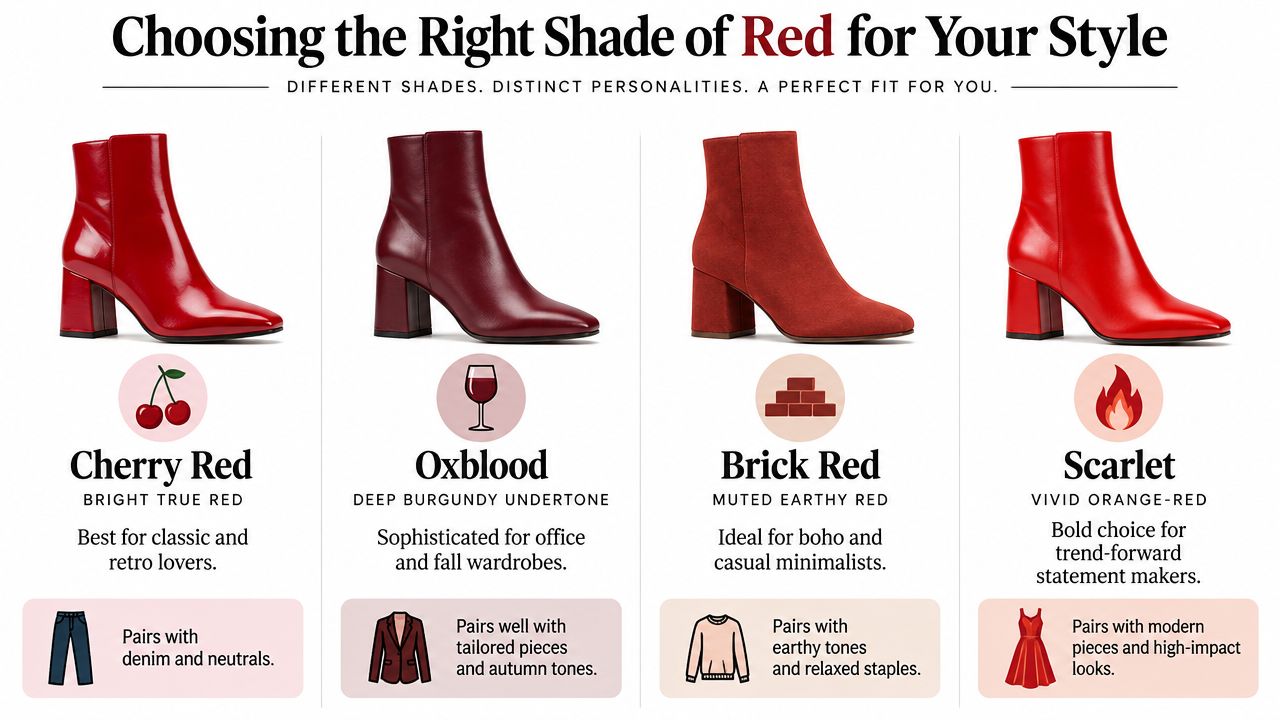
Burgundy and oxblood sit closest to the neutral end of the spectrum. Their wine-like depth works with charcoal, navy, dark denim, camel, cream, olive, and black. If you dress for an office, build outfits around a small capsule wardrobe, or want one pair to carry you from weekday meetings to weekend dinners, start here.
Burgundy also looks refined in polished leather, brushed leather, and suede. It can echo the warmth of autumn clothing without looking overly seasonal. For many wardrobes, it's the strongest alternative to black because it provides colour while preserving visual restraint.
Brick red has an earthy, muted quality. It works particularly well with tan, chocolate brown, faded denim, ecru, khaki, and textured fabrics such as corduroy or wool. Choose brick if your style leans casual, artisanal, bohemian, or minimalist and you prefer colours that look softened rather than saturated.
Brighter reds for deliberate impact
Cherry red is a true, lively red with a classic feel. It pairs easily with denim and neutral clothing, especially white, navy, grey, black, and tan. Cherry boots suit shoppers who enjoy a retro influence or want their footwear to be unmistakably visible.
Scarlet usually carries a warmer, orange-red energy. It's more theatrical and works best when the rest of the outfit stays clean and simple. Think straight black trousers, a plain knit, and a vivid scarlet ankle boot. The boot should be the statement, not one element in a crowded composition.
Match the shade to your actual wardrobe
Hold your boots beside the colours you wear most, not the clothes you wish you wore. If your wardrobe is built around black, grey, navy, and denim, nearly every red family can work, but burgundy will blend most naturally. If you wear camel, cream, brown, and olive, brick and oxblood will look grounded. If your outfits already include bright white, cobalt, pink, or graphic prints, cherry or scarlet can create a confident colour relationship.
Fall and winter trend coverage has placed dark red, burgundy, and cherry alongside suede, moto, and knee-high silhouettes, while Canadian retailers are merchandising dedicated red and burgundy boot edits through current seasonal footwear collections. The useful takeaway isn't that you need to follow a trend. It's that deep red has moved into the practical styling conversation, where it functions more like a fresh neutral than a novelty colour.
Matching Materials to Canadian Weather Conditions
A red boot can look luxurious and still perform poorly on a Canadian sidewalk. The upper determines appearance, maintenance, and resistance to moisture, but the outsole determines much of your stability.
Full-grain waterproof leather is the most dependable choice for shoppers who want a polished boot that can handle regular city wear. It resists light moisture better than untreated suede, develops character with care, and generally looks appropriate with both formal clothing and denim. It still needs protection from salt and slush, and no leather boot should be treated as automatically waterproof because it's made from leather.
Suede has a softer, more relaxed finish, but it demands stricter weather management. Salt stains, wet snow, and repeated slush exposure can quickly change its appearance. Choose suede red boots for controlled winter use, indoor-heavy routines, or dry transitional weather, not as your only pair for long outdoor commutes.
Modern synthetics can offer practical resistance to moisture and easier cleaning, although their quality varies. Look for a lining that manages moisture, secure seams, a gusseted tongue where relevant, and construction that doesn't leave the foot exposed at the ankle or shaft opening.
Put outsole chemistry before decorative tread
For icy sidewalks, tread pattern alone isn't enough. Canadian coverage on winter footwear reports that embedded-fibre or mineral-filled soles, including Green Diamond, Vibram Arctic Grip, Icelandic Grip, and IceFX, outperform conventional winter outsoles on ice, while most standard winter boots sold in Canada fail slip tests, as explained in this Canadian winter boot traction guidance.
That distinction is critical. A decorative lug pattern may look rugged, but the compound touching the ice does the work. If you'll wear red boots on untreated paths, icy intersections, or packed snow, prioritise a tested winter compound over a smooth fashion sole.
Safety comes first: Red is the design feature. The outsole compound and tread architecture determine whether the boot is suitable for ice.
For wet pavement, road salt, and contaminated surfaces, look for rubber or nitrile outsoles described as oil-resistant and slip-resistant. Canadian workwear guidance notes that slip-resistant outsoles can achieve coefficients above 0.5 in laboratory testing, and CSA or ASTM-rated women's work boots commonly combine waterproof leather or suede uppers with nitrile or rubber outsoles, according to Canadian women's work boot specifications. For additional seasonal outfit ideas, compare your options with this guide to women's boots for fall.
Building Outfits Around a Statement Boot
Start with the outfit you already wear, then replace the neutral shoe with the red boot. That approach keeps the styling realistic and shows you whether the pair belongs in your life.
The easiest formulas to repeat
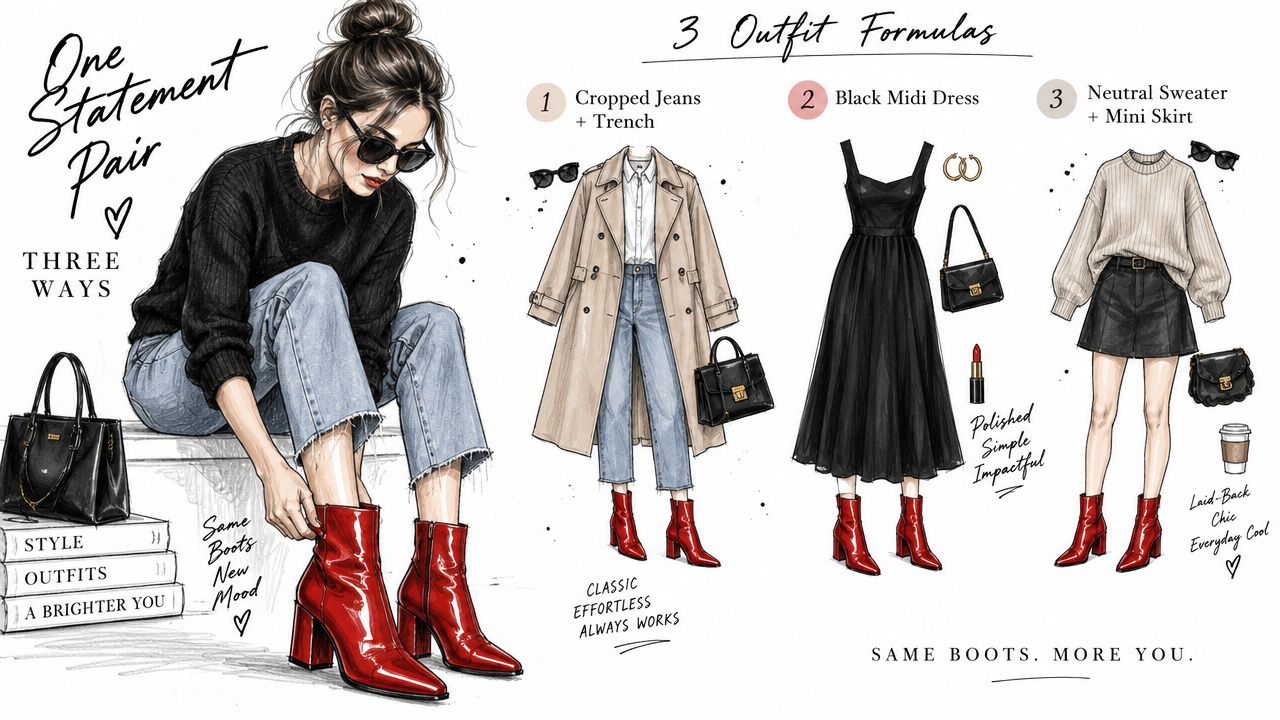
Straight-leg denim, a neutral knit, and red ankle boots is the most reliable starting point. Use dark denim with burgundy or oxblood for a refined effect, or faded denim with cherry or brick red for a more casual finish. Keep the hem clean enough to show the boot shaft without bunching over the vamp.
Black trousers, a cream top, and a red boot create strong contrast without looking busy. This combination suits pointed-toe ankle boots, sleek block heels, and polished knee-high styles worn under wider trousers. Add a black belt or handbag if you want the outfit to feel more anchored.
Camel outerwear, dark trousers, and deep-red boots is especially effective in autumn and winter. The warmth of camel gives burgundy and oxblood a polished setting, while the dark trousers keep the leg line uninterrupted.
A simple dress, opaque tights, and red boots turns the footwear into a clear styling decision. A floral dress can work if the print includes a related warm colour, but a solid knit or shirt dress gives the boots more authority. For western-inspired pairs, use the same restraint recommended in this guide to styling cowgirl boots with a dress.
Use colour echoes sparingly
The anchor-and-echo technique works when the repeated colour is small. A burgundy scarf, tortoiseshell frame with warm red tones, berry lipstick, or a subtle red stripe in a knit can connect the boots to the outfit. Don't force an exact match. Related depth and temperature look more modern than a perfectly matched accessory set.
Proportion matters just as much as colour. Pair chunky moto boots with trousers, a fitted knit dress, or a simple column of denim. Balance sleek ankle boots with wide-leg trousers, a long coat, or a fluid skirt so the footwear doesn't look visually stranded.
This video offers another visual reference for coordinating statement footwear with everyday clothing.
If you're unsure, remove one competing detail. Red boots already create emphasis, so you rarely need a dramatic neckline, oversized jewellery, a loud print, and a bright handbag in the same outfit. Let the boot lead and make the rest support it.
Selecting the Best Silhouette for Your Proportions
Boot height changes the visual line of your outfit. It also changes where the boot fits into your daily routine, so choose the shaft based on both body proportions and practical use.
Ankle boots offer the widest rotation
Ankle boots are the safest first purchase because they work with jeans, trousers, skirts, and dresses. A slight heel can lengthen the leg line without making the boot difficult to walk in, while a block heel provides a steadier base than a narrow stiletto.
A pointed or almond toe creates a longer, sharper impression. A round toe looks softer and gives the foot a more relaxed profile. Chunky soles add visual weight, so balance them with structured clothing or lower halves rather than delicate, overly fussy pieces.
Ankle boots also transition more easily between seasons. You can wear them with denim in autumn, trousers in winter, and dresses in spring, provided the outsole and lining suit the weather.
Mid-calf and knee-high styles need more planning
Mid-calf boots can interrupt the leg at its widest visual point, especially when the shaft ends against a contrasting hem. They work best with skirts or dresses that either expose the leg above the shaft or continue in a similar colour below it. Slim trousers tucked inside can also create a clean line.
Knee-high boots make a stronger statement and can be exceptionally elegant with midi skirts, sweater dresses, and structured coats. The calf fit matters more than the label. A gap can make the boot look borrowed, while an overly tight shaft restricts movement and becomes uncomfortable over layers.
Fit test: Sit, walk, bend your knee, and wear the socks you'll actually use before deciding that a tall boot fits.
The best silhouette is the one you'll reach for repeatedly. If you commute, walk outdoors, and move between heated interiors and cold streets, a stable ankle or lower shaft may outperform a dramatic knee-high boot. If your wardrobe centres on dresses and long coats, knee-high boots can provide the visual foundation that ankle styles can't.
For a neckline and outfit balance that complements a tall boot, the same proportion-first thinking applies to dresses with V-neck styling. The clothes and footwear should create one continuous line rather than compete for attention.
Evaluating Cost Per Wear and Long Term Value
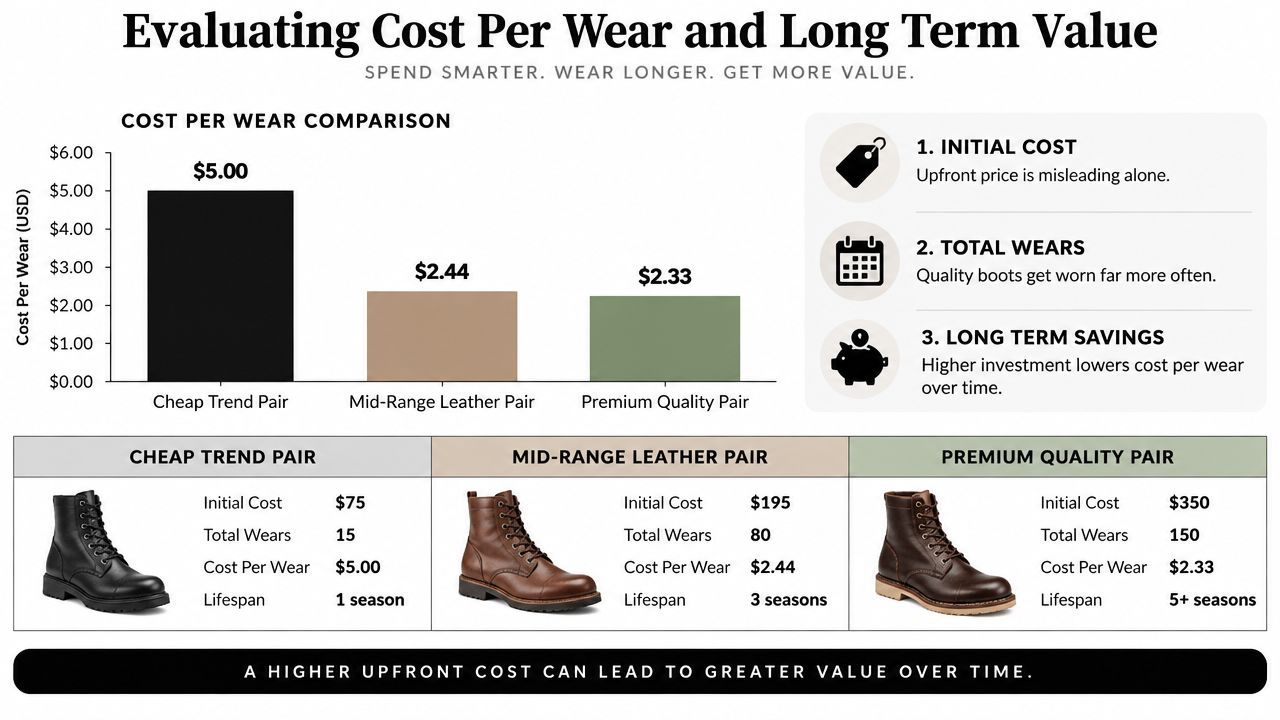
A red boot earns its place through repeated use, not colour alone. Choose a shade that works with your wardrobe, a fit you can tolerate for hours, and construction that handles Canadian winter conditions.
Canadian footwear research identifies comfort, fit, durability, and price-to-quality value as common consumer concerns. Style alone plays a much smaller role in satisfaction, particularly for women, according to the Canadian footwear consumer research. Apply that standard to red boots. A striking finish cannot offset heel pain, weak traction, salt damage, or a shaft that conflicts with your trousers.
Calculate the purchase by use
Before buying, check four points:
- Can the boots work with at least three existing outfit categories?
- Does the sole suit the ice, pavement, and indoor surfaces you regularly encounter?
- Can you clean, condition, or protect the upper?
- Does the construction permit professional repair or resoling?
A welted or otherwise repairable design can support a higher price when the upper, fit, and outsole are also sound. Price alone proves nothing. Inspect the stitching, sole attachment, heel stability, lining, zip quality, and finishing around the shaft. For Canadian winters, give extra attention to slip resistance and an outsole compound suited to icy ground.
Historical market data also supports judging leather fashion boots as a considered purchase. A federal study estimated a $109.0 million opportunity for Canadian-manufactured leather fashion boots and recorded an average price of $77, as shown in the archived Canadian footwear market study.
If you will wear red boots only with one dress, assess them as occasion footwear. If the same pair works with denim, trousers, skirts, dresses, and several coats, each wear strengthens the purchase. Red functions as a neutral-adjacent colour when the shade matches your wardrobe. Limited compatibility, not brightness, is what weakens long-term value.
Stepping Out With Confidence in Red Footwear
The idea that red boots are only for trend-focused dressers is wrong. Women of every age can wear them, but the styling needs to look deliberate. Confidence comes from choosing the right level of intensity, not from pretending the colour is invisible.
A deep burgundy boot is the easiest entry point because it behaves beside dark neutrals. Cherry red is more noticeable, but it remains simple to style with denim, black, grey, cream, and navy. Scarlet demands the most restraint, so keep the outfit's lines clean and avoid adding several competing statement pieces.
Canadian retail listings show that red boots are widely available, with Walmart Canada carrying more than 1,000 red-boot items and Canadian footwear marketplaces offering hundreds of listings, as shown in Walmart Canada's red boot assortment. The challenge isn't finding red boots. It's filtering the options intelligently.
Use this final checklist before buying:
- Shade: Choose burgundy or oxblood for maximum wardrobe flexibility, brick for earthy casual dressing, cherry for classic impact, or scarlet for a high-visibility statement.
- Weather: Match the upper and lining to your exposure to moisture, salt, slush, and cold.
- Outsole: Prioritise tested slip resistance and suitable winter compounds over decorative tread.
- Silhouette: Select ankle, mid-calf, or knee-high based on your clothes, proportions, walking needs, and calf fit.
- Value: Judge the pair by expected use, comfort, repairability, and cost per wear rather than colour novelty.
Red boots don't need to dominate your wardrobe. They need to give your existing wardrobe somewhere to go.
Wear them with the outfit you'd normally choose in black or brown. Repeat them often. Once the colour becomes familiar, you'll stop treating the boots as a special event and start recognising them as one of your most useful styling tools.
Fashion, Bags & More offers women's footwear alongside apparel, handbags, jewellery, and accessories, with collections and CAD pricing available for shoppers in Canada. Visit Fashion, Bags & More to browse pieces that can help you build complete outfits around a practical, statement-making pair of red boots.