You're probably here because a regular trainer feels a bit too casual, but a classic heel feels like too much work.
That gap is exactly where sneaker wedges make sense. They promise a little lift, a slightly sharper shape through the leg, and the familiar feel of a lace-up or slip-on upper. For many women, that's the appeal. Not drama. Just a shoe that can carry a weekday outfit a little further without asking you to commit to a pump.
In Canada, this isn't some obscure category hiding in the corner of the internet. Retailers actively sort and sell it as a real women's footwear option. DSW Canada has a dedicated women's wedge category and identifies wedge sneakers within it, while The Shoe Co. Canada lists women's wedge lifestyle sneakers. Canadian pricing also shows the style across different retail tiers, including a C$49.99 wedge sneaker at The Shoe Co. and a C$110 wedge heel jogger sneaker at ALDO Canada, which points to broad adoption across mass and fashion segments in the Canadian market (DSW Canada wedge category).
That matters because sneaker wedges womens searches usually come from a practical question, not a fashion history question. You want to know if this kind of shoe will help with your outfit, your commute, and your comfort. You also want to know whether it still looks current.
This guide treats sneaker wedges as what they really are. A hybrid. Part sneaker, part wedge, part styling shortcut.
Table of Contents
- Introduction to Sneaker Wedges and Why They Matter Now
- How Sneaker Wedges Are Built From Sole to Upper
- Comfort Fit and Support You Can Actually Feel
- When to Choose Sneaker Wedges Over Flats or Heels
- Styling Sneaker Wedges for Everyday Outfits
- Are Sneaker Wedges Still on Trend in Canada
- Your Smart Buying Checklist Before You Buy
Introduction to Sneaker Wedges and Why They Matter Now
A common getting-ready moment goes like this. You've got straight-leg jeans, a knit top, maybe a casual blazer, and the outfit is close. But your everyday trainers make it feel flat, while your dressier heels make it feel overdone.
That's the exact job sneaker wedges were built to do. They sit between categories that usually ask you to choose one benefit at a time. Trainers give ease. Heels give height. Wedges try to spread your weight more broadly than a narrow heel. Sneaker wedges combine pieces of all three.
Why this style keeps showing up
The reason they matter now isn't only trend language. It's retail behaviour. In Canada, the category has stayed visible long enough to move beyond a one-season novelty. Major retailers still maintain wedge and wedge-sneaker assortments, which is a strong clue that shoppers continue to buy them for everyday wear, not only for nostalgia.
There's also a broader shape shift happening inside the wedge family. ZARA Canada lists “Sneakers with heel detail” at C$39.90, alongside wedge shoes priced from about C$69.90 to C$229.00. ALDO Canada sells “Platform sneakers: wedge & chunky running shoes,” including the Iconistep wedge-heel jogger sneaker at C$110. SOREL Canada lists women's wedge sandals and platform styles at sale prices around C$77.50 to C$85.00 CAD against regular prices of C$155 to C$170 CAD. That spread shows how the Canadian market now treats wedge footwear as a broad family that includes sporty hybrids, not only dressy sandals or occasion shoes (ZARA Canada wedge and heel-detail styles).
Big idea: A sneaker wedge isn't just “a sneaker with height.” It's a construction choice that changes how the shoe looks, feels, and styles compared with flats, heels, and chunky platforms.
What usually confuses shoppers
Most confusion comes from three places:
- Construction: Is the height hidden inside the shoe, built into the outside sole, or both?
- Comfort: Will the lift push your foot forward and crowd your toes?
- Styling: Will they look polished, dated, sporty, or oddly in-between?
Those are fair questions. And the answers depend less on trend talk and more on how the pair is built, how your foot sits inside it, and what you plan to wear with it.
How Sneaker Wedges Are Built From Sole to Upper
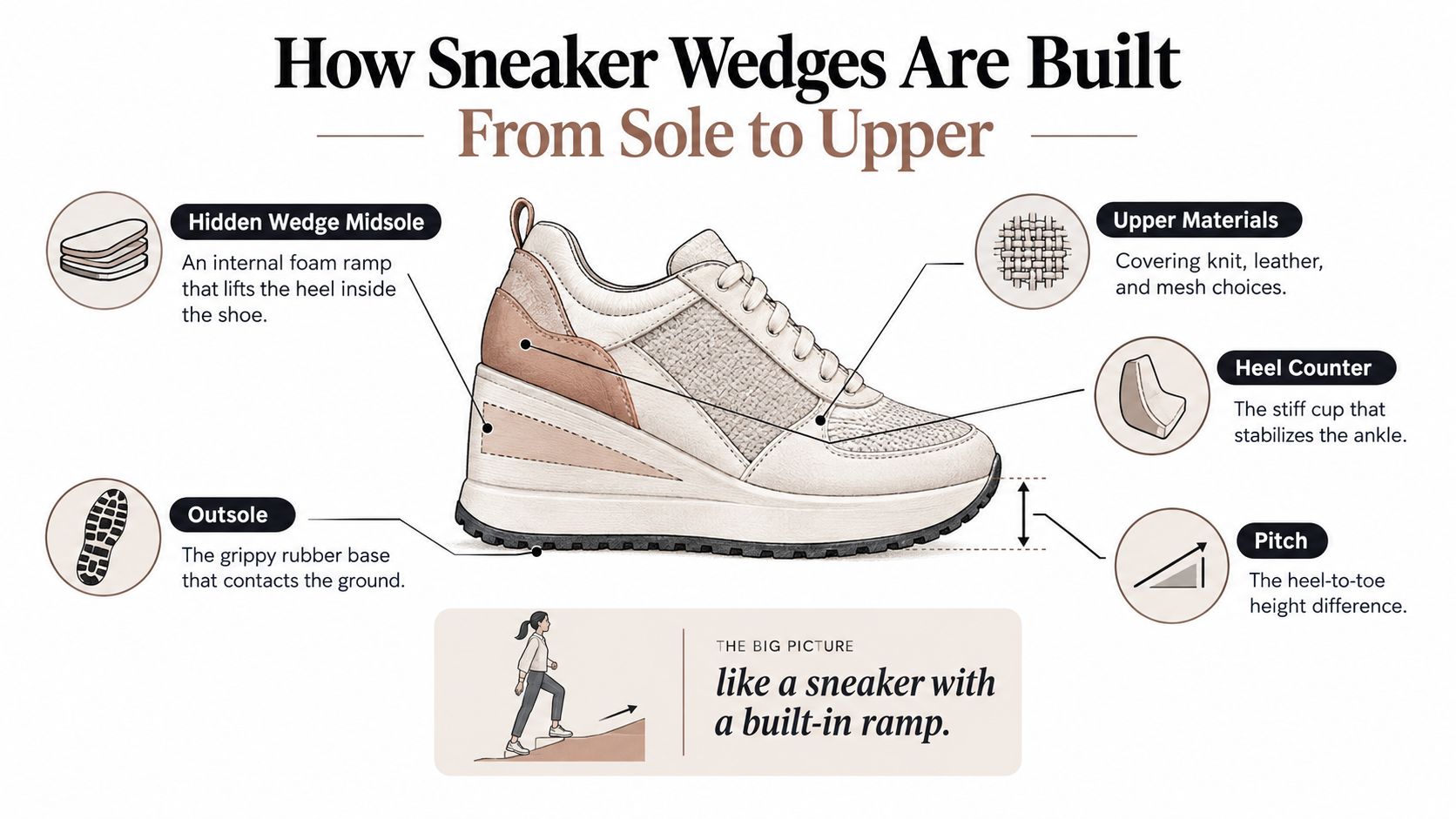
A sneaker wedge is easiest to understand if you think of it as a sneaker with a built-in ramp. Instead of your foot sitting level from heel to toe, the inside or outside of the sole rises gradually toward the heel.
The sole does most of the work
Start at the bottom.
The outsole is the part that touches the ground. In a good everyday sneaker wedge, this should give you decent grip and a stable contact area. A wedge can feel steadier than a narrow heel because more of the sole meets the floor, but that only helps if the outsole is shaped sensibly.
Above that sits the midsole, and in this category, that's where the wedge usually lives. Some pairs hide the lift inside the shoe so the outside still looks close to a trainer. Others show the rise openly, creating a more obvious fashion shape.
Then there's pitch, which is the heel-to-toe difference. Two shoes can look equally tall from the side but feel completely different on foot if one drops sharply toward the toe and the other rises more gradually.
A steep shoe asks more from the front of your foot. A gradual one usually feels easier to walk in.
The upper and rear structure control the feel
Move upward and the next key piece is the heel counter. That's the firmer cup around the back of the shoe. In a wedge sneaker, it matters more than many people realise because your foot is sitting on an incline. If the rear of the shoe is too soft, your heel can shift or slip even if the size seems right.
The upper materials shape the rest of the experience. Leather often gives more structure. Knit and mesh can feel more flexible and casual. Mixed-material uppers usually try to balance hold with softness.
If you browse a fashion-led pair like these rhinestone lace-up wedge sneakers, you can often spot the main design decisions just from the product photos. Look at the side profile, the thickness under the heel, and whether the ankle area appears firm or collapsible.
What to check on a product page
Before you even try a pair on, scan for these clues:
- Side profile: A sharply rising heel usually feels dressier and less forgiving than a lower, smoother lift.
- Toe shape: A narrower front can crowd the forefoot once your foot shifts forward on the incline.
- Closure: Laces usually help more than purely decorative straps because you can tune the fit.
- Collar and heel area: A structured back often supports the wedge concept better than a floppy one.
A sneaker wedge can look simple from the outside. Underneath, it's doing more engineering than a flat trainer.
Comfort Fit and Support You Can Actually Feel
The biggest comfort mistake with sneaker wedges is treating them like ordinary trainers.
They're not. The moment your heel is lifted, your foot behaves differently inside the shoe. That's why a pair that looks roomy on the shelf can still feel cramped after a short walk.
Why wedge height changes fit
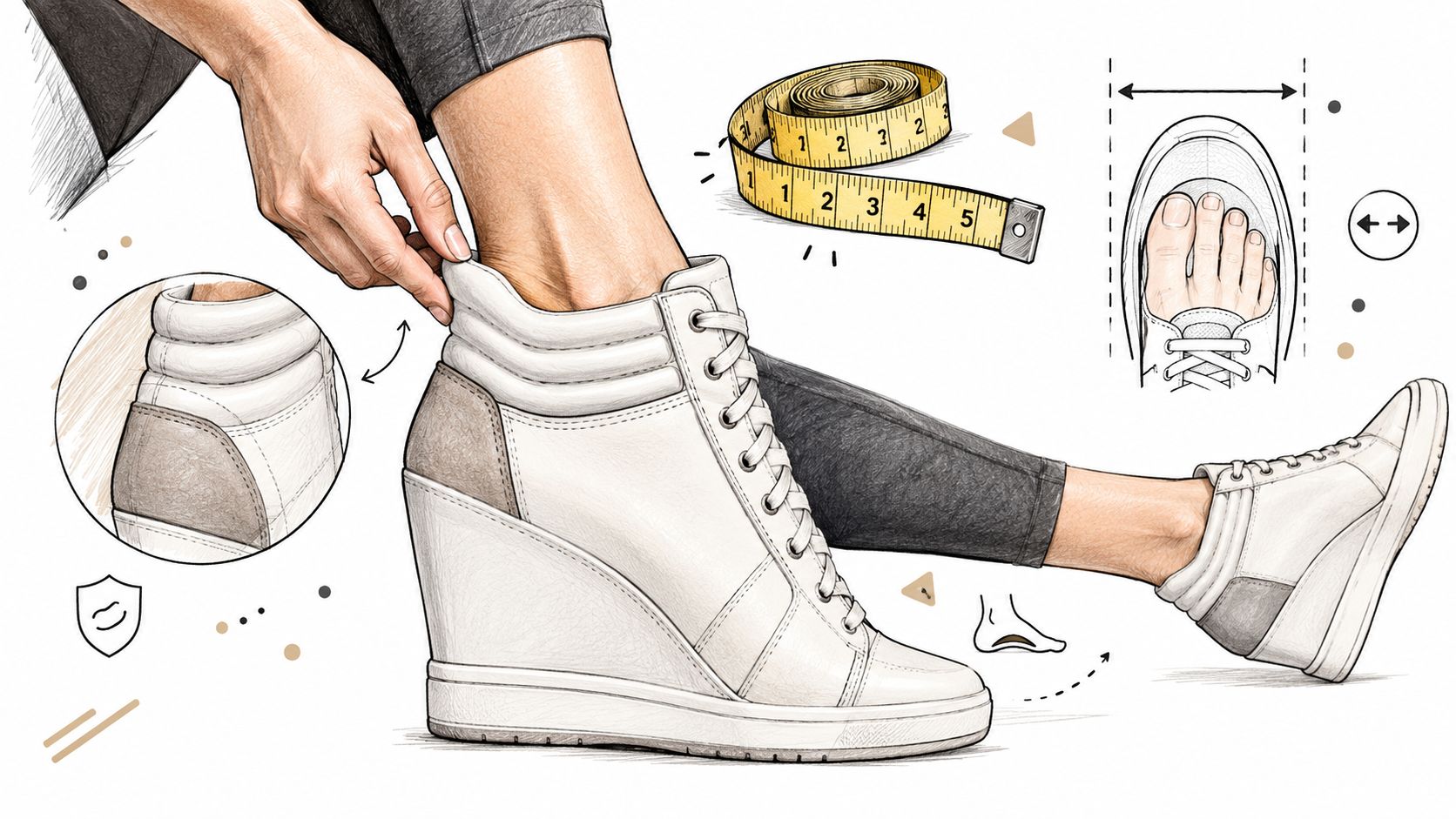
Biomechanical and fit research on wedge-heeled shoes found that under wedge-heel conditions, the foot becomes longer, flatter, and slimmer, which helps explain why such shoes can create pressure concentration and why stable heel counters, roomy toe boxes, and careful pitch matter so much in wear (research on foot morphology in wedge-heeled shoes).
That sounds technical, but the lived version is simple. Your foot slides and spreads in a different way than it does in a flat. If the front of the shoe is narrow, you'll feel it faster. If the heel area is loose, your foot may chase stability with every step.
Width matters more than many shoppers expect
Canadian footwear sizing often uses both size and width guidance. UGG Canada's fit guidance for women's footwear shows medium-width labels around 3.0 to 3.4 inches depending on size, which is useful because width should be checked along with length rather than guessed from your usual number alone (UGG Canada size and fit guidance).
For sneaker wedges, that's especially important. The sole can amplify forefoot crowding if the last runs narrow.
Here's a simple home test:
- Wear the socks you'll use. Thin no-shows and thicker casual socks can change the fit.
- Stand, don't just sit. Your foot spreads differently once your weight is on it.
- Check toe freedom first. You want space to wiggle, not a hard stop at the front.
- Walk on a hard floor. Carpet hides pressure points.
- Notice the ball of foot. If that area starts to complain quickly, the pitch may be too aggressive for you.
Practical rule: If a wedge sneaker feels only “slightly tight” in the forefoot during the try-on, it usually won't feel better after a full day.
Support signs you can feel right away
Comfort isn't only softness. In this category, support often feels like containment.
Look for:
- A secure heel hold so the back of your foot doesn't lift as you walk.
- A toe box with breathing room because the incline already asks more from the front of the shoe.
- A balanced pitch that doesn't dump your weight forward.
- An upper that bends where your foot bends, not across a pressure point.
A quick walk test helps more than squeezing the midsole with your thumb, but both tell you something. Softness alone won't rescue a poor shape.
This short visual can help you think through those comfort checks before you commit:
When to pause on a pair
Some warning signs aren't subtle:
- Your toes feel pushed together.
- The heel slips even when laced properly.
- You feel immediate pressure under the forefoot.
- The shoe tips you forward instead of holding you centred.
If any of those happen in the fitting stage, don't talk yourself into them. A sneaker wedge should feel supportive and purposeful, not like a compromise you're already managing.
When to Choose Sneaker Wedges Over Flats or Heels
Not every outfit problem needs a sneaker wedge. Sometimes a flat is still the better answer. Sometimes a proper heel gives the cleaner finish. The trick is matching the shoe to the job.
The decision is about function first
Choose sneaker wedges when you want some height, some polish, and reasonable walkability in the same pair.
That's different from what flats do best. Flats usually win when you need easy movement and a lower visual profile. Classic heels usually win when the outfit needs a sharper, dressier line. Chunky platform sneakers tend to lean more casual and streetwear-driven.
A useful shortcut is to ask one question: Do I want this outfit to feel more refined, or more relaxed?
If the answer is improved but not formal, sneaker wedges often land in the sweet spot.
Choosing Between Sneaker Wedges Flats and Heels
| Footwear Type | Height and Comfort | Best For |
|---|---|---|
| Sneaker wedges | Adds lift with a broader base than a narrow heel. Usually easier to walk in than dress heels, but more fit-sensitive than flats. | Casual office looks, dinner plans, travel days when you still want shape, polished everyday outfits |
| Flats | Lowest lift and usually the easiest starting point for all-day casual wear. Won't lengthen the leg line in the same way. | Errands, relaxed outfits, long standing days, simple commuting |
| Classic heels | Most obviously dressy. Can sharpen posture and silhouette, but usually asks more from the foot. | Events, evenings out, formal settings, outfits that need a refined finish |
| Chunky platform sneakers | Height comes from thickness rather than a wedge angle. Reads more sporty and current-casual than dressy. | Streetwear, off-duty dressing, wide-leg trousers, casual weekend looks |
A few real-life use cases
For a casual office, sneaker wedges often outperform both extremes. They usually look more intentional than basic trainers but less rigid than pumps. If your wardrobe includes cropped trousers, dark denim, knit dresses, or simple blazers, they can bridge those pieces neatly.
For a more dressy outing, a true heel still tends to look cleaner. If that's the lane you need, this guide to kitten heels with a pointed toe shows a different route that keeps some elegance without going full stiletto.
If you're dressing for movement plus polish, sneaker wedges often beat heels. If you're dressing for precision and formality, heels still have the edge.
When they're the wrong choice
Sneaker wedges aren't ideal for every situation.
Skip them when:
- The dress code is clearly formal. The sporty upper may undercut the outfit.
- You need maximum ground feel. A flat trainer will usually feel more natural.
- Your trousers pool at the ankle. The wedge shape can get visually lost.
- You dislike any forward pitch. Even a mild incline can feel wrong if you strongly prefer level shoes.
This isn't about one style being better than another. It's about choosing intentionally instead of hoping one pair solves every outfit.
Styling Sneaker Wedges for Everyday Outfits
The easiest way to style sneaker wedges is to stop treating them like a statement shoe.
They usually work best as a proportion tool. They add a little height, clean up the line of an outfit, and give casual clothes a more finished base. Once you see them that way, outfit planning gets much easier.
Jeans and straight-leg trousers
Many women start here, and for good reason.
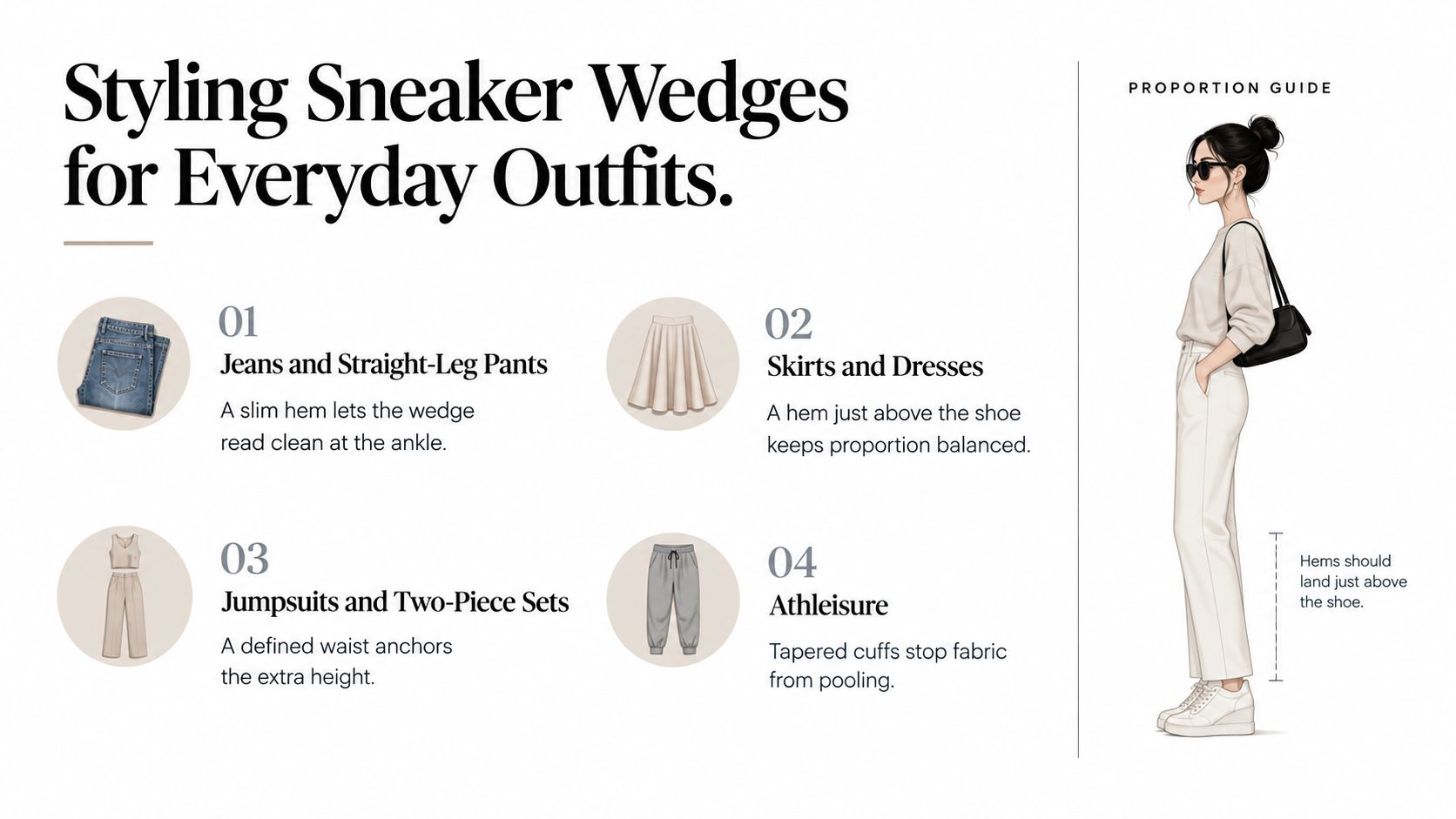
A straight or slim hem lets the wedge show at the ankle, which helps the shoe read clearly instead of disappearing under fabric. Dark denim with a clean white or black wedge sneaker usually looks more polished than distressed denim with lots of competing detail.
Good formula:
- straight-leg jeans
- fitted tee or fine knit
- cropped jacket or blazer
- sneaker wedges in a clean finish
Less helpful formula:
- long flared hem
- bulky sock
- heavily detailed wedge
- oversized top with no shape
The second combination can make the lower half feel visually heavy.
Skirts and dresses
Sneaker wedges can soften a dress without making it feel too athletic. The key is hem placement.
A hem that lands just above the shoe, or clearly above the ankle, usually keeps the proportions balanced. Midi lengths can work well if the fabric has movement and the shoe doesn't look too bulky.
A sporty upper and a feminine hem can work together nicely when the silhouette stays clean.
Jumpsuits, sets, and casual matching looks
A jumpsuit or coordinated two-piece set often benefits from the extra lift of a wedge sneaker because the height helps the full outfit hang a little better.
Look for a defined waist or some visual structure through the middle of the body. That keeps the added sole from making the whole look feel blocky. This is especially useful if you like one-and-done outfits but still want some shape.
Athleisure and weekend wear
This is the lane where many shoppers overdo it.
Sneaker wedges already bring visual interest. You usually don't need every other element competing for attention. Tapered joggers, a fitted hoodie, and a clean crossbody often work better than oversized sweats with a highly embellished shoe.
A few quick cues help:
- Do keep colour tight. Neutrals or tonal dressing make wedge sneakers easier to wear.
- Do match the finish to the outfit. Sleek uppers suit cleaner outfits. Chunkier textures suit casual looks.
- Don't pile on hardware. If the shoe has shine, keep the rest calmer.
- Don't hide the ankle completely. A bit of visible shape usually improves the line.
Sneaker wedges are often at their best when the outfit around them is simple. They don't need a lot of help.
Are Sneaker Wedges Still on Trend in Canada
This is usually the question beneath the search.
Not “What are they?” but “Am I buying into something dated?”
They're current, but not in the loudest way
In Canadian fashion coverage, wedges are reappearing as a fashion statement, but the bigger sneaker story centres on hybrid silhouettes that blur sporty and feminine design, including sneakerinas and sneaker mules. That makes sneaker wedges feel less like the headline trend and more like an established option inside the wider hybrid-footwear conversation (Elle Canada coverage of wedge shoes and hybrid styles).
That distinction matters. A style doesn't have to dominate fashion coverage to be worth buying. Some of the most useful shoes are the ones retailers continue to stock because they solve a reliable wardrobe problem.
Trend piece or wardrobe staple
Sneaker wedges sit in an interesting middle ground.
They're not as directional as newer hybrids, and they don't always get the editorial spotlight. But Canadian retail assortments show that the category persists across price bands and store types. That usually signals staying power.
If you're trying to build a wardrobe on a budget, that can be good news. A shoe doesn't need to be the newest silhouette to earn its place. It just has to work with what you wear.
For shoppers comparing trend-forward buys with steadier everyday options, it can also help to look at broader alternatives to fast-fashion shopping, such as this guide to a Shein alternative in Canada.
What usually explains the price spread
In Canada, local listings show wedge sneakers ranging from clearance pricing to around CAD 135, and much of that spread comes down to design choices rather than one simple “better or worse” hierarchy. Materials, sole design, finish quality, visible hardware, and how structured the shoe feels all affect where a pair lands.
A lower-priced pair may still work well if the shape fits your foot and your wardrobe. A pricier pair may justify itself through better materials or a cleaner silhouette. The useful question isn't “Is this expensive?” It's “Does this construction, fit, and finish suit how I'll wear it?”
Your Smart Buying Checklist Before You Buy
By the time you're ready to click “add to cart,” the goal isn't to find the most dramatic pair. It's to find the pair that earns repeat wear.
That usually comes down to a few checks that connect construction, comfort, and styling in one quick decision.
The shortlist that saves mistakes
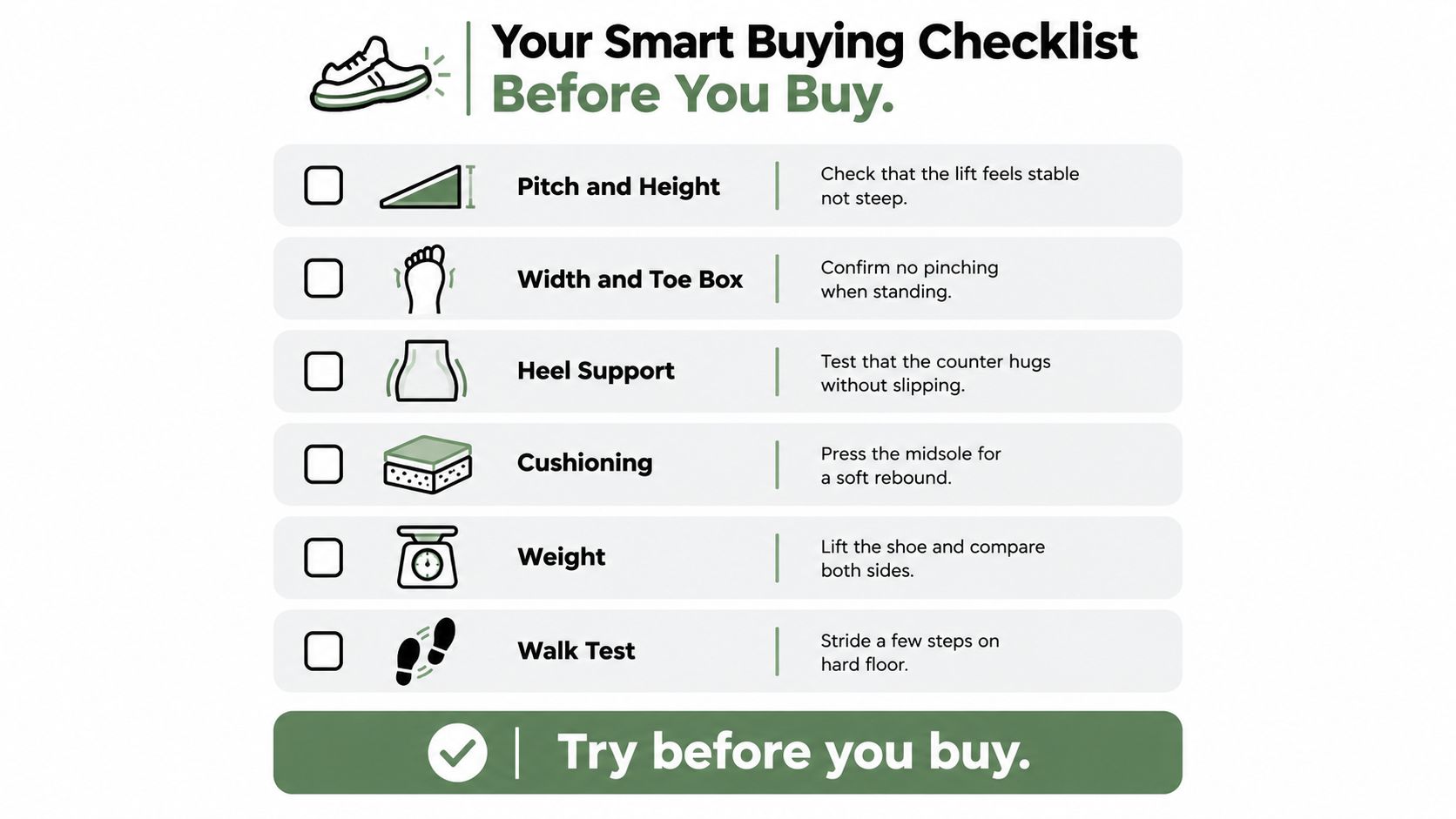
Use this before you buy:
- Pitch and height: The lift should feel stable, not like it's pushing you onto your toes.
- Width and toe box: Your forefoot needs room once you're standing, not just when seated.
- Heel support: The back of the shoe should hold you in place without rubbing or slipping.
- Upper material: Think about whether you want structure, stretch, or a balance of both.
- Weight: If the shoe feels heavy in your hand, it may feel tiring after several hours.
- Walk test: Even a few indoor steps can reveal pressure points quickly.
Buy for outfits you already own
One of the smartest filters is wardrobe compatibility.
Ask yourself whether the pair works with at least a few things you already reach for. Straight-leg jeans, cropped trousers, knit dresses, casual sets, and simple skirts are often good tests. If a pair only works with one imagined future outfit, it's probably not the right everyday buy.
Buy the pair that solves a real dressing problem in your week, not the pair that only looks exciting on the product page.
Keep the shopping process practical
When you compare options online, use search and collection filters to narrow by colour family, closure type, and overall silhouette first. Then check the price in CAD, review the photos from the side and back, and read the return policy before you commit.
Those small habits help more than chasing a perfect trend label. The best sneaker wedges womens purchase is usually the pair you can wear without fuss, style without overthinking, and trust for more than one type of day.
Fashion, Bags & More offers CAD-priced women's footwear, apparel, handbags, jewellery, and accessories, which makes it easier to build outfits around hybrid shoes like sneaker wedges instead of shopping across multiple sites. If you want to compare sneakers, heels, sets, and accessories in one place, visit Fashion, Bags & More and browse by collection, search, or region to find pieces that suit your everyday style.